
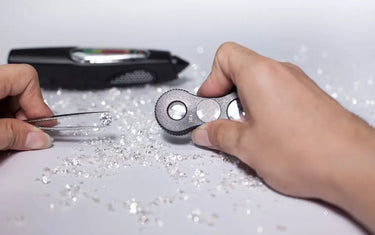
Moissanite and diamonds share nearly identical thermal properties, making misidentification a costly mistake for jewelers and buyers. Even with professional multi-testers, improper probe technique or environmental factors can trigger false readings. Master these five field-tested testing practices to eliminate testing errors, protect your profit margin, and ensure 100% accurate results every time.

Tip 1: Master the Probe Contact Angle & Applied Pressure
The micro-thermal sensor inside an electronic diamond tester is exceptionally sensitive. How you apply the probe tip to the stone's surface directly dictates signal transmission quality.
- Maintain 90° Vertical Contact: The probe tip must remain perfectly perpendicular to the gemstone's table facet. Tilting the device reduces the contact surface area, causing heat to dissipate unevenly and altering the sensor reading.
- Apply a Constant, Light Touch: Press the probe against the stone just enough to slightly compress the internal spring mechanism. Avoid applying heavy force—excessive pressure deforms the delicate probe tip over time and shifts thermal resistance measurements.
- Target the Flat Table Facet: Always place the probe on the flat, smooth table of the stone. Never attempt to test on kite facets, pavilion main facets, or the thin girdle, as these narrow angles prevent complete sensor coverage.

Tip 2: Eliminate Metal Frame & Setting Interference
Precious metals like 18K gold, 950 platinum, and silver possess exceptionally high thermal conductivity rates—far higher than gemstone minerals. Touching the metal frame during a test compromises the reading instantly.
The Metal Thermal Conductivity Trap
If the probe tip accidentally bridges the gap between the gemstone and a metal prong, heat transfers immediately into the setting. The device misinterprets this rapid heat loss, often triggering a false "diamond" or "moissanite" alert on non-diamond stones or throwing an error code.
Precision Positioning Practices
When inspecting mounted jewelry, stabilize your hands on a rubber bench block or brace your wrist against the counter. Use a jeweler’s loupe or binocular microscope to watch the probe tip make contact, ensuring it touches solely the gemstone surface without brushing adjacent prongs or bezels.
For high-value estate buys or critical appraisals, unmount the stone or secure the piece with insulating, non-conductive tweezers rather than holding it with bare fingers.

Tip 3: Standardize Surface & Sensor Cleaning Protocols
A clean interface is vital for accurate thermal and electrical conductivity testing. Outer layers of grime act as thermal insulators, blocking accurate readings.
Surface Cleaning Requirements
Human skin oils, fingerprints, polishing wax compounds, and dust create an invisible barrier on the gemstone. Before powering up your tester:
- Wipe the gemstone thoroughly using a high-density, lint-free microfiber cloth.
- For heavy wax or grease build-up, clean the stone with a cotton swab dampened with anhydrous isopropyl alcohol and allow it to dry completely.
Probe Maintenance Protocols
Residual dust and skin oils can also collect on the tip of the micro-sensor. Gently wipe the probe tip across a clean piece of paper or specialized sensor cleaning pad before starting a new batch of testing. Never use abrasive materials or harsh solvents directly on the micro-probe.

Tip 4: Control Working Environment & Allow Pre-heating/Cooldown
Gemological testing equipment reacts dynamically to ambient room temperatures and air circulation patterns. Maintaining environmental control stabilizes the internal circuit logic.
- Startup Warm-up & Calibration: Allow the instrument to complete its full electronic self-test and warm-up cycle upon turning it on. Always execute a zero-point calibration check against the factory-included test stone prior to testing unknown inventory.
- Cooldown Intervals Between Tests: Testing multiple stones in rapid succession accumulates ambient heat inside the probe tip. Pause for 3 to 5 seconds between individual tests to let the probe return to baseline temperature.
- Avoid High-Airflow Environments: Drafts from air conditioner vents, overhead fans, or open shop doors alter the probe's thermal convection sensing. Conduct tests in a stable indoor setting with consistent ambient room temperature (20°C to 25°C).

Tip 5: Monitor Battery Stability & System Voltage
Inconsistent power delivery causes system logic errors in micro-processor-driven jewelry tools.
Low-Battery Drift Risks
When battery voltage drops below the optimal operating threshold, the heating element inside the probe heats unevenly. This voltage drop leads to reading drift, where identical stones return completely different results within minutes of each other.
Power Management Recommendations
- Commercial Bench Operations: Use a dedicated, voltage-stabilized AC power adapter for stationary bench setups in retail shops or processing centers.
- Field Inspections: Replace batteries immediately when the low-battery indicator illuminates. Use high-drain, leak-proof alkaline or premium lithium batteries, and remove them if storing the device unused for long periods.
Conclusion
Mastering moissanite and diamond identification comes down to consistency. While quality hardware provides the foundation, adhering to a strict testing SOP—controlling contact pressure, eliminating metal contact, keeping surfaces clean, maintaining stable environment temperatures, and managing power supplies—guarantees accurate results every time.
Ready to upgrade your gemological setup with reliable, shop-tested equipment? Visit LuxgoldTools to explore our selection of high-precision moissanite testing equipment and professional bench supplies.
