
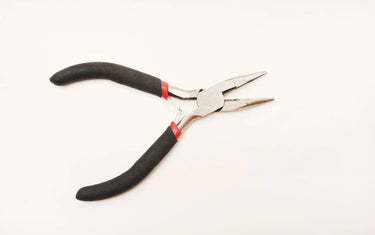
Chain nose pliers are the indisputable workhorse of every jeweler’s bench, bridging the gap between firm grip and microscopic control. However, improper handling often causes unsightly tool marks, distorted wire, and hand fatigue. Mastering a few essential techniques will sharpen your precision and cut down on tedious cleanup and polishing time.

Trick 1: The Scratch-Proof Jaw Hack
Working with soft or clad precious metals—such as 14K gold-filled, dead-soft sterling silver, or fine copper wire—demands a non-marring approach. Raw, hardened tool steel can easily bite into unhardened wire during high-tension manipulation, leaving unsightly serration lines, micro-dents, or scraped-off metal layers that weaken structural integrity.
- Apply a protective buffer: Wrap the flat inner faces of your plier jaws with a single layer of medical paper tape (micropore tape) or slide a short piece of heat-shrink tubing over each tip and shrink it tight. For a custom-molded, removable grip, dip the tips directly into a liquid rubber coating like Tool Magic.
- Maintain jaw hygiene: Replace tape and rubber coatings periodically. Over time, adhesive binders collect microscopic metal filings and polishing compounds that act like sandpaper, turning an old buffer into an abrasive hazard.

Trick 2: The Lateral Twist for Perfect Jump Rings
Pulling jump rings apart horizontally stretches the circumference of the metal out of round, permanently destroying its radial symmetry. Once stretched open this way, forcing the ends back together creates an awkward oval profile and leaves a structural weak point.
- Dual-plier stabilization: Grasp each half of the jump ring immediately adjacent to the split using two pairs of pliers. A dedicated pair of chain nose pliers in your dominant hand paired with flat nose pliers (or a second pair of chain nose pliers) in your non-dominant hand gives you maximum rotational leverage.
- Axial shear movement: Open the ring strictly along its central axis—pushing one side forward while pulling the other side backward.
- The spring-back snap: When closing the jump ring, reverse the motion and gently push the seam slightly past dead center before releasing. Listen and feel for that subtle metallic "click" as the ends pass and interlock flush. This spring-tempered closure guarantees a continuous, gap-free loop that won't release fine beading cord or delicate chain links.

Trick 3: Position-Based 90° Bends
The tapered geometry of chain nose pliers—transitioning smoothly from a broad heel at the pivot down to a needle-fine tip—functions as an intuitive, built-in graduated sizing gauge when calibrated correctly.
- Calibrate your jaw points: Using an ultra-fine permanent marker or a fine-tip scribe, lay down clean reference lines across the flat inner jaw face at defined intervals (e.g., 2 mm, 4 mm, and 6 mm from the tip).
- Execute uniform production runs: Align your wire directly against the designated reference mark every time before levering the wire against the jaw edge. By keeping your wire placement fixed relative to the jaw width, you guarantee identical 90-degree bend radiuses and uniform loop stems across batches of headpins, eye pins, and handmade ear wires.

Trick 4: The Tight-Space Wire Tuck
A professionally finished wire wrap must never snag knitted fabrics or scrape against delicate skin. Trimming wrapped coils with side cutters often leaves a microscopic, razor-sharp tail that standard flush cutters simply cannot sever cleanly against the core wire.
- Leverage the slender cone profile: Take advantage of the ultra-slender nose and curved outer contour of your pliers. Slide the very tip directly into the recessed channel between the coiled wire wraps and the central core wire.
- Roll, don't crush: Rather than squeezing the tail flat with brute force—which can dent the core wire—apply gentle, rolling wrist pressure to sweep and tuck the sharp tail snugly into the coil groove until it sits completely flush with the surrounding wraps.

Trick 5: Micro-Straightening for Ear Posts and Delicate Wire
Attempting to straighten a kinked 925 silver ear post, earring hook, or delicate wire component with your fingers concentrates mechanical stress directly onto the localized bend point, inducing work-hardening and causing the metal to snap.
- Utilize broad, flat jaw contact: Rest the warped post or wire deep along the broad, flat clamping zone near the base of the jaws where mechanical leverage is most evenly distributed.
- Apply pulsed micro-pressure: Gently pulse light pressure with the pliers while slowly rotating the component in quarter-turn increments. Work sequentially along the length of the distorted section. The wide, polished steel flats gradually redistribute tension along the wire grain, restoring true alignment without crushing round profiles or weakening the metal.

Trick 6: Crimp Finishing and Burr Flattening
While specialized multi-step crimping pliers are required to notch and fold crimp tubes securely onto beading wire, the final fold can occasionally leave behind sharp lateral flares, squared corners, or rough seam edges.
- Refine the crimp profile: Once the crimp tube is securely locked into place, grip the folded component between the flat, smooth jaws of your chain nose pliers.
- Eliminate sharp burrs: Apply light, uniform micro-squeezes while rotating the crimp 90 degrees. This smooths down crisp edges, rounds out protruding corners, and transforms rough crimps into polished, snag-free anchors that glide comfortably against the wearer's neck.

Trick 7: Jaw Chamfering and Tool Maintenance
Even high-end, brand-new pliers fresh out of the package can feature crisp 90-degree edges along the outer perimeter of the jaws. These sharp factory corners can act like dull shearing blades against soft wire during high-tension bends.
- Break the factory edge: Use an 800- to 1200-grit micro-abrasive sanding stick or a fine silicone polishing wheel on a rotary tool to lightly round the outer perimeter and corner transitions of your plier jaws.
- Polish to a mirror finish: Regularly inspect your jaw faces for micro-galling or indentations caused by hard steel components. Buff the flat faces periodically with a high-grit abrasive paste and a felt bob. A smooth, mirror-polished jaw allows precious metal to glide effortlessly without catching or scuffing.
Upgrade Your Bench Setup
Precision jewelry assembly relies on tools that function as a natural extension of your hands. Ultra-fine tips, perfectly aligned jaws, zero lateral play, and responsive spring actions separate frustrating bench sessions from effortless, clean craftsmanship.
When it is time to upgrade your daily bench lineup and safeguard your precious metal designs, discover the professional-grade hand tools at LuxgoldTools. Engineered with dual leaf-spring mechanisms, box-joint construction, and hand-finished, mirror-polished smooth jaws, our Chain Nose Pliers deliver the uncompromising grip, tactile feedback, and lasting durability your jewelry deserves.
