
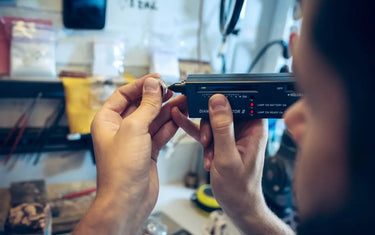
Outdated thermal pens cannot separate moissanite from natural diamond, turning a simple misread into thousands in lost capital or damaged bench tools. There is no universal tester for every jeweler. Finding the right tool means matching your specific stone sizes, work environment, and budget to the right technology.
Step 1: Clarify "Your" Testing Profile Before Spending

Before browsing spec sheets or pricing, evaluate how and where you will use the instrument. Defining your baseline prevents overspending on lab features you will never touch—or buying an underpowered pen that fails in the field.
Error Tolerance and Financial Exposure
Are you conducting live acquisitions at trade shows, estate sales, or over a pawn counter? In these environments, error tolerance is zero. You need an instrument engineered to identify sophisticated, low-conductivity synthetics, including coated stones and modern colorless silicon carbide that trick entry-level sensors. Conversely, if you are a jewelry enthusiast checking personal purchases, a basic, multi-step screening setup offers plenty of protection without commercial overhead.
Stone Geometry and Carat Thresholds
Evaluate the physical size of your inventory:
- Large center stones (≥ 1.0 ct): Standard industrial probes with standard tip diameters handle these easily without slipping.
- Micro-pavé and melee (0.01 to 0.02 ct): Standard tips are too broad; they bridge the gap between stone and mounting, triggering false metal alerts. You need dedicated micro-probe tips engineered specifically for tight prong work.
Workspace Ergonomics and Power Delivery
- Fieldwork & Mobile Sourcing: Demands lightweight ergonomics, durable drop-resistant construction, replaceable alkaline or rechargeable lithium power, and zero warm-up delays.
- Stationary Benches & Counters: Requires dedicated AC/USB power options. Leaving a tester running on battery power all day causes voltage drops that skew electrical and thermal readings.
Step 2: Choose by Your Role — Which Specific Tester Fits You Best?
Match your workflow to the single piece of hardware engineered specifically for your operating environment.
If You Are a Pawnbroker or Estate Buyer → GEMORO® UltraTester 3+

- The Problem It Solves: Field acquisitions expose you to sophisticated fraud, particularly top-tier Forever One™ moissanite. Its ultra-low electrical conductivity slips past conventional testers, registering as diamond and leading to expensive buy-in errors.
-
Why It Fits Your Workflow: The UltraTester 3+ utilizes proprietary UV-F1 technology paired with dual thermal/electrical sensing to identify tough, low-conductivity synthetics. Its high-visibility light pipe delivers immediate, unmistakable feedback:
- Blue: Moissanite
- Green: Natural Diamond
- Pink: White Sapphire / Simulant
- Red: Metal Alert
- Practical Edge: Housed in an impact-resistant, rubberized body powered by rechargeable NiMH AAA batteries or USB-C, it is built to survive field use and dim estate environments without misreadings.
If You Are a Bench Jeweler or Repair Studio → Presidium Adamas

- The Problem It Solves: Testing closely spaced micro-pavé settings on finished pieces often leads to snapped probe tips when working around prongs. Traditional testers require shipping the entire unit back to the manufacturer for factory servicing, leaving your bench dead in the water.
- Why It Fits Your Workflow: The Adamas features an interchangeable magnetic probe system. If a tip bends or breaks during fabrication, you pull it off and snap on a fresh one in seconds, eliminating studio downtime.
- Practical Edge: When fitted with the optional micro-probe tip, the spring-loaded, retractable mechanism tests melee stones down to 0.01 ct. Continuous USB power allows you to keep it powered at the bench all day without battery-drain drift.
If You Are a Showroom Seller or Retailer → SmartPro Reader-I 3-in-1

- The Problem It Solves: Consumer trust evaporates if an appraisal device looks generic, flickers, or forces the salesperson to squint at tiny lights while the customer watches skeptically across the counter.
- Why It Fits Your Workflow: The Reader-I features an expansive 160-degree wide-angle LCD screen. Clear digital readouts allow the customer to observe the verification process from the opposite side of the counter, reinforcing full transparency.
- Practical Edge: Integrated Bluetooth connectivity syncs test results straight to the SmartPro mobile app, allowing you to log appraisal batches, attach digital certificates, and export records for customer documentation. Its standard 0.48mm retractable tip tests stones as small as 0.01 ct (1.0mm) right out of the box.
If You Are a Hobbyist or End-Consumer → Presidium Moissanite Tester II (PMT II)

- The Problem It Solves: Many buyers already own an affordable thermal tester (like an entry-level Diamond Selector). While great for weeding out cubic zirconia or glass, thermal units read moissanite as genuine diamond. Buying a complete multi-tester to double-check occasional purchases can be cost-prohibitive.
- Why It Fits Your Workflow: The PMT II serves as a dedicated, low-cost step-two electrical verification tool. After your basic thermal pen indicates "diamond," the PMT II tests electrical conductivity to confirm whether that stone is natural diamond or silicon carbide.
- Practical Edge: Weighing just 50 grams, it features a specialized non-slip polymer probe tip that prevents accidental surface scratches on prized jewelry—an essential safeguard for non-professional users.
Step 3: Filter Your Choices by Key Technical Deal-Breakers

Review these non-negotiable specifications before finalizing your choice:
1. Dual-Testing Technology (Thermal + Electrical Conductivity)
Thermal conductivity alone cannot separate moissanite from natural diamond. Basic thermal pens and models featuring simple UV inspection lights rely entirely on heat dissipation rates. If an instrument lacks an active electrical conductivity circuit, do not use it to detect moissanite.
2. Probe Tip Diameter & Spring Resistance
- Standard Tips (~0.6mm): Reliable for loose or prong-set solitaire center stones down to roughly 0.05 ct.
- Micro-Probe Tips (≤0.48mm): Necessary for modern micro-pavé, halo settings, and channel settings holding stones down to 0.01–0.02 ct.
- Spring-Loaded Action: Look for a retractable tip with internal resistance. Rigid, stationary probes transfer hand tremors directly to the stone, causing slips, scratched mountings, and false metal warnings.
3. Workflow Efficiency: Recovery and Warm-Up Times
- Zero Recovery Time: Essential for batch processing. Lower-tier testers require 5 to 15 seconds to recalibrate internal heat sensors between stones. Professional models reset instantly, letting you test entire tennis bracelets stone by stone without pausing.
- Instant Warm-Up: Field work requires testers ready to fire the second the cap comes off. Avoid units with 30+ second heating cycles if you buy over the counter.
Summary Comparison: Which Tester Matches Your Needs?
|
Your Role / Scenario |
Recommended Model |
Why It’s the Best Choice |
Minimum Stone Size |
Power Supply |
|
Pawn Shops / On-Site Purchasing |
GEMORO® UltraTester 3+ |
UV-F1 detects ultra-low conductivity moissanite; vivid 4-color light display |
Standard sizes |
USB-C / Rechargeable AAA |
|
Jewelry Artisans / Repair Studios |
Presidium Adamas |
Magnetic swappable probes (zero downtime); tests tight micro-pavé |
0.01 ct (with micro-probe) |
Continuous USB / AAA Batteries |
|
Retail Counters / Showrooms |
SmartPro Reader-I 3-in-1 |
160° wide-angle LCD for client transparency; Bluetooth app data logging |
0.01 ct (0.48mm tip) |
Optional AC Adapter / AAA |
|
Personal Use / Jewelry Enthusiasts |
Presidium PMT II |
Accessible second-step electrical testing; scratch-safe polymer tip |
0.05 ct |
AAA Batteries (50g pocket unit) |
Final Checklist: How to Ensure Accuracy Once You Choose
Even a high-end testing unit will produce false positives or intermittent errors if used incorrectly. Follow this operational checklist on every pass:
- Clean and Degrease the Gemstone: Diamonds and moissanite attract oils, skin lotions, and polishing rouge. Wipe the facet tables thoroughly with a microfiber or lint-free alcohol cloth before testing. A layer of grease acts as a thermal insulator, skewing electrical and heat transfer readings.
- Maintain Strict 90° Vertical Contact: Align the probe perpendicular to the table facet of the stone. Push down smoothly until the spring mechanism engages midway. Angled approaches bend probe barrels, lead to improper contact areas, and slip onto adjacent mountings.
- Isolate the Setting from Metal Alerts: If your tester emits an intermittent metal alert, your tip is contacting a prong, bezel, or solder seam rather than the stone itself. Lift the probe completely, stabilize the ring in a non-conductive stone holder or ring clamp, and center the tip on the table facet.
Choosing the right moissanite tester comes down to matching your daily work to the right tool: estate buyers need the fraud-proof detection of the GEMORO® UltraTester 3+, bench jewelers benefit from the zero-downtime modular design of the Presidium Adamas, retailers can rely on the transparent display of the SmartPro Reader-I, and hobbyists can count on the affordable accuracy of the Presidium PMT II.
Ready to equip your bench or counter with professional appraisal tools? Explore our full collection of verified moissanite testers and testing equipment at LuxgoldTools to secure your business against diamond fraud today.
