
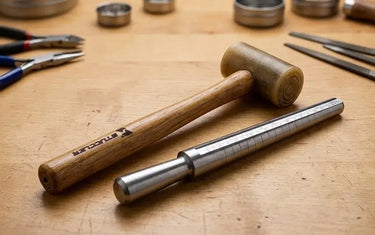
Ever spent minutes hammering a ring mandrel only for the band to stay stubbornly oval—or worse, accidentally smashed it a full size too big? While a rawhide mallet protects your metal from scratches, picking the right weight (in oz) is what actually saves your wrist and preserves your ring size. Here is how to skip the trial-and-error and find your "Goldilocks" mallet weight in under two minutes.
I. Understanding Mallet Weights: What Do 4 oz, 8.5 oz, 12 oz, and 20 oz Really Mean for Your Bench?
Choosing the right mallet isn't just about weight—it's about how head dimensions, internal density, and gravity interact with your metal against the steel mandrel. Here is a detailed breakdown of how each standard size performs during actual bench work.
1. 4 oz (Lightweight / Small Face): The Precision Feather

- Head Dimensions: ~32mm × 63mm
- Bench Feel & Physics: Ultra-agile and weightless—feels almost like holding an oversized marker. Because the smaller head contact area concentrates light force, it allows micro-level control without transferring heavy vibration to your wrist.
- Core Mechanics: Delivers precise, surface-level taps. It lacks the momentum to drive dense metal down the taper of a mandrel, virtually eliminating the danger of accidental over-stretching or thinning out a fine setting.
-
Best Suited For:
- Ultra-thin stacking bands and fine wire rings (1.5mm–2mm width).
- Soft, malleable metals including thin-walled sterling silver, fine silver (999), 18K/24K gold, and gold-filled sheet.
- True-up work around delicate mountings (such as claw prongs, channel settings, or micro-pave) where heavy shockwaves could shatter or dislocate gemstones.
2. 8.5 oz (Medium / Universal): The Workbench Sweet Spot

- Head Dimensions: ~48mm × 85mm
- Bench Feel & Physics: Perfectly weighted with an ideal power-to-control ratio. Incorporating a dense internal core, this mallet lets gravity do 70% of the work—you simply guide the arc of the swing.
- Core Mechanics: The ultimate "all-purpose" workhorse for 90% of jewelry studios. The wider head face spreads impact force evenly across standard band widths, snapping ovalized rings back into a flawless circle in just a few light rotations.
-
Best Suited For:
- Standard commercial ring profiles (2mm–5mm band width) in 925 sterling silver, brass, copper, and 14K gold.
- Correcting everyday dented, warped, or bent rings brought in for repair.
- General rounding and light resizing (up to 0.25–0.5 US size extension) without compromising band wall thickness.
3. 12 oz – 20 oz (Heavyweight & Lead-Weighted): The Power Resizer

- Head Dimensions: Up to 78mm–85mm face length with high-density internal lead weighting.
- Bench Feel & Physics: Substantial, solid, and authoritative. Advanced models feature a specialized internal lead core inside the rolled buffalo hide; this added mass drives high downward inertia into the stroke, eliminating "hammer bounce" off hard steel mandrels.
- Core Mechanics: Delivers maximum shaping momentum to overcome the natural material elasticity (spring-back) of thick or work-hardened metals. Instead of repeatedly beating a heavy band, a few decisive, weighted strikes smoothly push the ring down the mandrel taper.
-
Best Suited For:
- Wide men's bands, heavy signets, and thick shank profiles (6mm–10mm+ width).
- Work-hardened alloys, heavy gauge vintage silver, and tough base metals.
- Significant Ring Resizing: Expanding rings by 0.5 to 1+ full size (Stretching / Sizing Up) quickly and efficiently with minimal arm fatigue.
II. Quick Finder: Which Weight Do You Need Right Now?
-
Scenario A: "I'm a beginner in metalsmithing/DIY; which hammer should I buy first?"
- Recommendation: Go straight for the 8 oz. It offers the most forgiveness, handling everything from your first practice silver ring to later, more advanced prototyping.
-
Scenario B: "I like making ultra-fine, delicate stacking rings, or I have limited wrist strength."
- Recommendation: Choose 4 oz or 6 oz. They are lightweight and won't tire your hand; a single strike won't snap a delicate band or accidentally distort its size.
-
Scenario C: "I make heavy, vintage-style American silver jewelry or wide rings, or I frequently need to enlarge rings for clients."
- Recommendation: Choose 12 oz. It utilizes its own weight for natural, powerful strikes—saving effort while offering high efficiency for resizing.
III. Step-by-Step: How to True-Up & Resize a Ring Without Ruining It

Step 1: How to Hold the Ring Mandrel and Rawhide Hammer
Hold the ring mandrel at a 45° angle. Grip the rawhide hammer by the middle-to-rear section of the handle (avoid gripping too close to the hammerhead) and use a natural swinging motion—combining wrist movement and gravity—to strike.
Step 2: The 360-Degree Even-Tapping Method (Preventing Tapering)
Tap lightly along the top edge of the ring band while moving down the ring mandrel; rotate the mandrel 90° after every 3–4 taps.
Key Action: After completing one full rotation, you must remove the ring, flip it over, and place it back on the mandrel to tap it again. This prevents the inner circumference from becoming flared (wider at the top and narrower at the bottom).
Step 3: Controlling Force—Resizing vs. Rounding
- Rounding only: Use light, frequent taps, targeting only the raised areas.
- Resizing (Expanding): Use moderate force, tapping and pushing downwards along the mandrel; frequently check the ring size using a caliper or the mandrel's scale markings.
IV. Buyer’s Checklist & Care: Getting the Most Out of Your Mallet

What to look for when buying:
- Check that the rawhide coil is tightly wound and free of cracks.
- Ensure the wooden handle is smooth and free of splinters (a comfortable grip significantly reduces hand fatigue).
Care tips for beginners:
- Preventing cracking: Rawhide is a natural material; avoid placing it in direct sunlight or near heaters, though be aware that humid environments can cause mold.
- Sanding down burrs: If the mallet head's edge becomes frayed or deformed after prolonged use, gently sand it smooth with 400-grit sandpaper to restore it to like-new condition.
Ready to Upgrade Your Jewelry Bench?
A reliable rawhide mallet is every jewelry maker's most faithful studio companion. Whether you need a featherlight touch for delicate gold wires or heavy-duty momentum for resizing thick bands, choosing the right weight ensures your rings stay perfectly round while protecting your precious metal from unwanted scratches.
Explore our professional collection at LuxgoldTools to find the exact match for your workshop setup:
- Shop 4 oz Rawhide Mallet – Ideal for ultra-thin bands, delicate gemstone settings, and light micro-adjustments.
- Shop 8.5 oz Rawhide & Lead Mallet – The universal bench sweet spot for standard 925 silver, brass, and everyday ring rounding.
- Shop 12 oz Rawhide & Lead Mallet – Built with heavy shaping momentum to stretch thick bands and wide men's rings effortlessly.
Upgrade your workbench with LuxgoldTools today and experience effortless, precision ring making on every project!
