
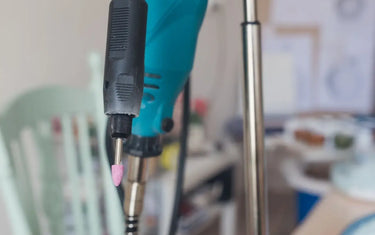
Fine rotary carving demands extreme micro-control, zero tip vibration, and low-speed cutting power. While a handheld rotary tool excels at rapid stock removal around the house, micro-carving delicate materials exposes the mechanical divide between an all-in-one handheld unit and a dedicated flex shaft system.
I. Comparison of Handling and Control: Flex Shaft Handpiece vs. Dremel Body
Micro-carving requires the same fluid control as hand lettering. The physical format of the tool directly influences how cleanly your bur tracks along tight layout lines.

1. Physical Differences in Weight and Precision
A dedicated flex shaft handpiece typically weighs between 100g and 180g with a slim, balanced profile. This allows for an authentic three-finger pen grip, resting comfortably in the crook of your thumb. Because the heavy motor hangs above the workbench, tactile feedback transfers straight from the bur tip to your fingertips with minimal center-of-gravity drag.
Conversely, an all-in-one Dremel unit packs its motor, housing, and power delivery into the handle, tipping the scale at 450g to 650g. Trying to carve intricate micro-reliefs with that bulky, rear-heavy housing feels like trying to write delicate calligraphy while holding a soda can. Within 15 minutes, your forearm flexors strain to counteract the lever-arm weight, leading to hand fatigue and involuntary muscle tremors that can ruin a fine cut.
2. The Limitations of Add-On Flexible Shafts
Many carvers attempt to bridge this gap by attaching a flexible accessory (such as the Dremel 225) to their rotary tool. While this removes motor weight from your hand, it introduces secondary mechanical trade-offs:
- Core Wire Drag: The inner driving wire is narrow and stiff, producing noticeable torsional spring-back when bent at acute angles around a small piece.
- Shaft Kinking: Sharp handpiece orientations strain the outer casing, pulling your grip off-center.
- Vibration Transfer: Internal friction inside light-duty sheath channels transfers micro-vibrations straight into your palm, falling short of the smooth fluidity of a professional-grade steel flex shaft.
II. Cutting Performance Across Key RPM Ranges: Flex Shaft vs. Dremel
Torque delivery across specific speed bands determines whether a tool cleanly slices through material or destroys it with frictional heat.

1. The Golden Rule of Low-Speed Precision Carving
Precision carving thrives at moderate to low speeds. When detailing injection wax blocks, lost-wax carving blanks, dense hardwoods (such as African blackwood or boxwood), or styrene scale figures, excessive RPM causes rapid frictional heating. High speeds melt carving wax into a sticky paste that clogs bur flutes, scorches fine wood grain, and gums up delicate cutters.
2. Power Deficits at Low Speeds
A Dremel generates cutting power through centrifugal momentum, relying on 10,000 to 35,000 RPM to keep its bur moving. Dialing an all-in-one rotary tool down to the 1,000–3,000 RPM micro-carving sweet spot compromises motor output. The moment a fine carbide cutter bites into dense stock, the motor bogs down, chatters, and stalls completely.
In contrast, a dedicated flex shaft motor is built as an external, high-torque workhorse. Controlled via an analog or electronic foot switch, it pumps constant driving torque through the heavy-duty sheath even at 500 RPM. You can execute controlled, chip-by-chip shavings through stubborn grain or dense casting wax without the tool catching, jumping, or stalling out mid-pass.
III. Consistency in Carving Rhythm: Flex Shaft vs. Dremel
Controlling cutting speeds on the fly protects your workflow and keeps tool movement steady.

1. Creative Flow and Hand Stability
Executing micro-textures like animal fur, lettering, or prong undercuts requires anchoring both hands—one securing the piece against the bench pin, the other steadying the handpiece nozzle. Lifting either hand away breaks your visual orientation and point of contact.
2. A Qualitative Shift in Speed Control
A flex shaft relies on a heavy-duty foot pedal, turning speed control into an intuitive physical reflex:
- Entry: Feather the pedal to introduce the bur to the layout line at crawling speed.
- Pass: Apply smooth downward foot pressure to accelerate through the body of the cut.
- Exit: Ease off the pedal right as the flute clears the margin, clearing chips cleanly without over-cutting.
With an integrated rotary tool, altering speed means stopping your pass, removing a hand from the workpiece, and hunting for a slide switch or push button on the body. This disruption often leaves telltale chatter marks, uneven trench depths, or accidental tool slips when re-entering a delicate line.
IV. Tool Tip Runout and Bit-Changing Efficiency
Concentricity directly affects line crispness when working with miniature burs.

1. Concentricity with 0.5mm Micro-Bits
Carving sub-millimeter detailing requires micro-sized ball burs, bud burs, or tiny engraver cutters down to 0.5mm. At this scale, radial spindle play (runout) exceeding 0.03mm destroys line consistency.
Standard consumer rotary tools rely on cast internal spindle collars and aluminum multi-split collets, which can introduce runout that causes the tip of a fine bur to wobble. This wobble turns a crisp 0.5mm groove into an uneven 0.8mm gouge with chipped margins. Professional flex shaft handpieces incorporate matched industrial dual-ball-bearing sets within a rigid steel headstock, holding radial runout near zero for laser-straight tracks and clean margins.
2. Efficiency in Frequent Bit Changes
Complex carvings require constantly cycling through bur shapes:
- Flex Shaft Systems: Pairing your unit with an industry-standard quick-change handpiece (such as a lever-action collet handpiece) allows for one-second, one-handed tool swaps without wrenches. For irregular shank diameters from 0mm to 4.0mm, an adjustable, keyed Jacobs-style chuck handpiece holds bits with industrial clamping force.
- Dremel Systems: Swapping tooling requires holding down a spring-loaded spindle lock pin, seating a stamped open-end wrench, unthreading the collet cap, swapping the bit, and tightening everything down again. This extra friction adds up fast during multi-stage detailing.
V. Performance Across Common Micro-Carving Materials
| Material | Primary Hurdle | Flex Shaft Performance | Dremel Performance |
|---|---|---|---|
| Jewelry Carving Wax | Low melting point, flute clogging | Superior: High torque at low RPM shaves crisp ribbons without melting or friction buildup. | Poor: High minimum RPM melts wax, gums flutes, and leaves rounded edges. |
| Dense Hardwoods | Fiber tear-out, directional grain | Superior: Stable low-speed carving preserves fragile grain walls and delicate feathering. | Fair: Excellent for hogging out waste blanks; burns wood on delicate finishing cuts. |
| Resin & Miniatures | Heat-deformation, brittleness | Superior: Steady low-speed control avoids chipping delicate figure edges or thin walls. | Moderate: Efficient for rough parting-line grinding; unstable for fine recessed detailing. |
- Jewelry Wax Models and Prototyping: The flex shaft is the gold standard for jewelers. Running a cylinder or bud bur slowly lets you carve hollow undercuts, seat settings, and trim prongs without heat transfer melting the fragile wax structure.
- Hardwood Micro-Carving and Fine Texturing: Hardwoods like briar, ebony, and boxwood require measured cutter control to avoid splintering. A flex shaft slices cleanly through crossing grain lines, whereas a high-speed tool can glance off hard rings or scorch burn marks into the stock.
- Resin Models and Miniatures: For grinding away thick resin casting gates or flash lines, an all-in-one tool's high rotational speed clears waste fast. However, when scribing panel lines, hollowing faces, or cleaning up delicate cast hands, the precision grip and low-speed torque of a flex shaft prevent sudden runaways that could snap brittle resin.
VI. Choosing the Right Tool for Precision Carving: Which One Should You Buy?

1. When a Flex Shaft is a Must
Invest in a dedicated flex shaft system if you:
- Have a permanent workspace, workbench, or jewelry bench where a motor can hang overhead.
- Focus on fine-scale crafts like jewelry fabrication, stone setting, wax model carving, pipemaking, or netsuke wood carving.
- Require continuous carving sessions lasting longer than an hour without battling hand fatigue or an overheating motor housing.
- Depend on ultra-fine burs (under 1.5mm) that need zero tip runout to hold tight detail.
2. When a Dremel Will Suffice
A standalone rotary tool makes sense if you:
- Work without a dedicated bench and need a tool that packs easily into a toolbox or drawer.
- Carve casually, with the tool seeing most of its use on general DIY projects, rust stripping, cutoff wheels, plumbing cleanup, and home repairs.
- Primarily carve large, bold projects—such as chainsaw wood sculpture cleanups, outdoor sign routing, or aggressive material removal on big walking sticks.
3. A Smooth Transition for Existing Dremel Users
If you already own an integrated rotary tool, start with the official 225-style flexible shaft attachment to get used to carving with a pen-like grip.
Once your work pushes past entry-level detailing, you will likely hit familiar bottlenecks: the tool bogging down when dialed low, the handpiece running hot, and subtle bit wobble ruining high-stakes passes. When those limits start holding back your work, upgrading to a dedicated hanging flex shaft machine will give you the control, low-end power, and precision your carving demands.
Professional Hanging Flex Shaft System
Motor: High-Torque Reversible Drive | Foot-Pedal Speed Control
Core Feature: Constant 500 RPM Power • Prevents Wax & Resin Melting
Pumps steady cutting power through dense hardwoods and casting wax without bogging down. Ergonomic foot-speed control keeps both hands locked on the cut.
🟢 In Stock • Workshop Benchmark • Ready to Ship
🛒 Explore Flex Shaft Motors & Kits →Precision Quick-Change Handpieces
Bearings: Dual Matched Industrial Bearings (<0.02mm Play)
Advantage: 1-Second Toolless Bur Swaps • Featherlight Pen Grip
Eliminates bur wobble on 0.5mm micro-cutters. Swap carving bits instantly without wrenches and hold fine detail lines without hand fatigue.
🟢 In Stock • Heavy-Duty • Fast Dispatch
🛒 Browse Handpieces & Accessories →Take your bench work to the next level with smooth speed control and zero-play handling. Browse the professional selection of heavy-duty hanging motors, quick-change handpieces, and micro-machined rotary tooling at LuxgoldTools to equip your workshop with the right setup today.
