
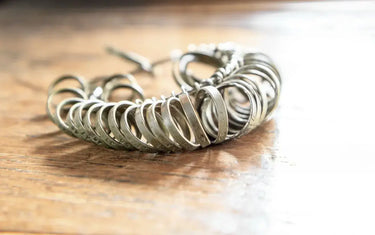
In custom jewelry design, a fraction of a millimeter can mean the difference between a flawless delivery and an expensive remake. Relying on cheap ring sizers with sloppy tolerances, rough edges, and unstandardized scales drains skilled labor and damages client trust.
Here is how professional jewelers evaluate, choose, and verify precision ring sizers to protect their craft and bottom line.
I. Four Core Criteria for Selecting a Professional Ring Sizer
When sourcing measuring tools for your workshop or showroom, avoid treating them as disposable accessories. Evaluate every ring sizer using these four professional benchmarks.

1. Extremely Low Manufacturing Tolerance and Internal Diameter Precision
The difference between a comfortable fit and a ring that slips off can be less than half a millimeter. High-grade measuring tools must maintain strict manufacturing consistency.
- Tolerance Control: Premium measuring rings maintain an internal diameter (ID) variance within ±0.05mm—achieving near zero-tolerance accuracy across the entire set.
- Standard Authority: Always verify which sizing scale the manufacturer adheres to—whether US, UK, European (EU), or Hong Kong/Japan (HK/JP) standards. Markings must be crisp, unambiguous, and aligned strictly with official ISO dimensions rather than arbitrary brand-specific measurements.

2. Material Selection and Structural Stability
The physical properties of the tool directly impact how well it holds its size over years of daily handling.
-
Metal Models (Stainless Steel / Chrome-Plated Aluminum Alloy):
- Why they excel: These offer maximum resistance to wear and structural deformation. They are built to withstand high-frequency use in workshops and retail showrooms without expanding or warping over time.
- What to avoid: Steer clear of cheap zinc alloy sets. Zinc alloys oxidize over time, develop a rough texture, and can bend slightly when dropped or compressed in a tool kit.
-
Plastic/PP Models (Sizing Belts & Gauge Rings):
- Why they excel: Flexible polypropylene (PP) zip-style gauges are perfect for mailing to remote clients for home measurement.
- What to evaluate: Look for high tensile strength so the band doesn't stretch and distort when pulled tight over a knuckle. Ensure the material is non-toxic, hypoallergenic, and clean-molded without sharp plastic flashes.

3. Profile Design and Wearability
Finger anatomy is complex, and a flat piece of metal doesn't measure the same way a finished piece of fine jewelry wears.
- Internal Profile Design (Comfort Fit vs. Flat): Professional jewelers stock Comfort Fit (domed interior) gauge sets. A rounded inner profile glides over the knuckle far more smoothly, accurately mimicking how high-end wedding bands and custom rings feel on the finger.
- Beveled Edges: Edges must be smoothly polished and chamfered. Unfinished, sharp-edged gauges compress soft skin tissue during fitting, which often tricks you into taking an inaccurately small measurement.
- Band Width Simulation: Fingers react differently to varying band widths. High-end gauge sets offer narrow (~3mm) and wide (~6mm+) options to account for the increased surface friction that wider bands create against the skin.

4. Marking Method and Readability
Clear labeling eliminates misinterpretations between your sales desk and your bench jeweler.
- Laser Engraving: Opt for deep laser-engraved numbers over surface printing or light stamping. Laser etching resists fading, even when exposed to workshop chemicals, polishing compound residue, or hand sweat.
- Multi-Standard Reference: Sets that display both the regional size (e.g., US Size 7) along with the exact inner diameter in millimeters or total circumference make cross-border orders and custom CAD modeling seamless.
II. Matching Ring Sizers to Usage Scenarios
No single measuring tool fits every stage of the custom jewelry workflow. Most professional studios utilize a two-tier setup.
|
Usage Scenario |
Recommended Tool Style |
Key Benefits |
|
In-Studio & Showroom Fitting |
Heavy-duty chrome-plated stainless steel or Comfort-Fit metal ring sets. |
Industrial-grade accuracy, premium tactile weight, superior customer experience. |
|
Sizing Kits for Remote Customers (Mailed) |
Polypropylene (PP) multi-tooth locking belt gauges or lightweight plastic sets. |
Low shipping weight, foolproof self-measurement, cost-effective, non-deformable. |
III. How to Inspect and Verify Your Ring Sizers Upon Delivery
Never put new measuring tools directly onto your showroom desk or workbench without auditing their precision first. To ensure your newly purchased ring sizers meet commercial standards, follow this straightforward three-step quality control audit:
- Step 1: Digital Caliper Inspection: Randomly select key benchmark sizes (such as US 5, 7, and 9). Measure the internal diameter across multiple angles using a calibrated digital caliper, then cross-reference the readings against the official ISO standard table.
- Step 2: Edge & Finish Inspection: Run your fingertips along the inner circumference and outer bevels of every gauge ring. Reject any set that exhibits burrs, rough seams, or sharp, unpolished rims.
- Step 3: Set a Master Sizer: Mark your most precise, verified metal set as the studio's Master Sizer. Keep this set reserved strictly at your main workbench to calibrate secondary sets and verify finished custom work before shipping.
Conclusion
For custom jewelers, the ring sizer serves as the primary precision link between the customer's finger and the finished ring. When selecting measuring tools for your business, paying a small premium for high-precision tolerances, Comfort-Fit beveled edges, and deep laser engraving protects your workbench from costly remakes and protects your brand's reputation for quality.
Ready to Eliminate Sizing Errors at the Bench?
Don't let inaccurate tools compromise your craftsmanship or eat into your margins. Explore our complete collection of commercial-grade metal gauge sets, comfort-fit measuring rings, and precision sizing kits at LuxGoldTools.
Shop Professional Ring Sizers at LuxGoldTools Today
