
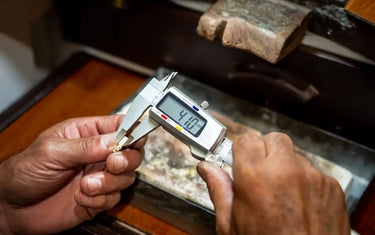
At the jeweler’s bench, a mere 0.01 mm error is the difference between a secure bezel and a shattered stone. Standard industrial calipers are simply too bulky, harsh, and clumsy for delicate gold or tight ring shanks. Here is how to pick a precision digital caliper that delivers micron accuracy—without marring your finest work.
I. Key Selection Criteria: 5 Specs Every Bench Jeweler Must Check
Industrial machinists prioritize drop resistance and high clamping force. Jewelers, however, need delicate tactile response, compact jaw profiles, and strict dimensional stability.

1. Resolution and Repeatability
For serious goldsmithing, standard display resolution must be 0.01 mm (0.0005"). However, display resolution is meaningless without repeatability.
- The Zero-Drift Problem: In diamond sorting and accent stone layout, you open and close your measuring tool dozens of times an hour. If the readout shifts by 0.02 mm to 0.04 mm upon closing the jaws, the tool suffers from zero drift.
- Why It Matters: A loose zero reading leads to inconsistent seat cutting with your hart burs, resulting in uneven prong heights or loose stones. Look for calipers that return cleanly to 0.00 mm every single time the measuring faces meet.
2. Jaw Geometry and Tip Thinness
Most standard hardware-store calipers have thick, blunt jaws designed to measure flat stock, pipes, or machine bolts.
- Internal Clearance: Thick upper jaws cannot slip inside a size 4 ring shank without hitting the curve prematurely, giving you an artificially small reading.
- Prong Accessibility: Standard lower jaws cannot reach into the tight gap between prongs or sit flat against a bearing cut.
- The Solution: Jewelers require knife-edge or fine-point jaws. These tapered tips fit cleanly into deep bezel grooves, tight channel walls, and delicate wax carvings without crushing adjacent detail.
3. Jaw Material: Hardened Steel vs. Non-Marring Jaws
Material choice directly impacts measurement reliability and workpiece safety:
- Precision-Ground Hardened Stainless Steel: Essential for fabricating metal stock, checking rolling mill output, measuring drawplates, and sorting hard minerals (sapphires, diamonds). Steel maintains parallel measuring faces over years of use.
- Carbon Fiber, Brass, or Synthetic Jaws: Steel jaws will easily scratch finished 18K yellow gold, gouge sterling silver, or chip delicate pearl nacre. Keeping a secondary carbon-composite or non-marring digital caliper at your bench lets you inspect finished, mirror-polished stock and soft gems (such as jade, turquoise, and pearls) without creating repair work.
4. Thumb Roller and Consistent Measuring Force
Jewelry materials are easily distorted under pressure. Squeezing thin-walled tubing, soft wax models, or fine silver round wire with unguided fingers creates elastic deformation, yielding false, undersized readings.
A smooth thumb roller gives your hand micro-tactile feedback. It allows you to advance the slider with consistent, minimal measuring force, ensuring the jaws touch the material just enough to register the true dimension without compressing the piece.
5. Workbench Protection (Dust & Splash Resistance)
Bench jewelers work surrounded by conductive metal filings, abrasive pumice, polishing compound splatters, and wax shavings. If fine gold dust or moisture gets trapped behind the capacitive sensor scale, the digital display will freeze or skip values.
An IP54 rating offers verified dust and splash resistance, protecting internal capacitive sensors against bench grime and rogue mist from your steam machine or ultrasonic bath.
II. Matching Calipers to Common Jewelry Workflows
No single measuring tool excels at every stage of jewelry fabrication. Match your instrument's configuration to the task at hand:
-
Stone Setting & Gem Sorting:
Prioritize instruments with high repeatability, low electromagnetic interference, and absolute encoder chips. Stone sorting requires rapid, zero-error measurements where you measure hundreds of calibrated rounds without resetting the datum. -
Fabrication, Wire Drawing & Sheet Sizing:
Requires maximum mechanical rigidity. Choose an all-stainless steel frame with a solid depth rod to gauge channel depths, collet heights, and rolling mill sheet thickness under continuous friction. -
Ring Sizing & Wax Carving:
Demands ultra-thin internal measuring nibs. Measuring carved wax rings or sizing joints requires minimal clamping force to avoid denting the soft carving wax. -
Finished Jewelry Quality Control:
Use lightweight carbon fiber or protective composite calipers. QC inspections should never introduce scratches or micro-abrasions to high-polish precious metal surfaces right before packaging.
III. The Pitfalls of Cheap $10 Digital Calipers on the Bench
Budget bargain-bin calipers may seem economical, but they routinely cause expensive bench errors:

- Ghost Readings & Fluctuations: Low-tier circuit boards lack shielding against electromagnetic interference (EMI). The magnetic transformers in bench lamps, micromotors, and overhead fluorescent lights can cause cheap LCD readouts to flicker or jump by full millimeters, causing you to over-cut costly gold stock.
- Lack of Jaw Parallelism: Budget calipers use stamped rather than precision-ground blades. While the tips might touch, the base often reveals visible light gaps. Measuring a thick gemstone girdle versus a thin sheet on the same tool yields contradictory dimensions.
- Parasitic Battery Drain: Poorly engineered units feature soft-off switches that keep the internal sensor powered even when the LCD is off. After leaving the tool in your bench drawer for three weeks, you find the LR44 or CR2032 button cell dead just when you need to confirm an order.
IV. Jeweler’s Pro Checklist: Daily Care & Measurement Best Practices
To protect your caliper's precision, incorporate these routine bench habits:
- Wipe the Jaws Before Every Zero Reset: Gold dust, rogue investment powder, or a stray flake of carving wax measures roughly 0.02 mm to 0.05 mm thick. Always slide the jaws lightly against a lint-free bench cloth before closing and zeroing the display.
- Use the "Rolling" Technique on Round Stones: When sizing loose round faceted stones, don't merely clamp the table and culet. Gently rotate the stone between the flats of the jaws to catch the maximum girdle diameter, ensuring your pre-cut setting bur sits flush.
- Clean Rails Without Abrasives: Metal dust eventually binds with oil on the beam, making the slide feel gritty. Never clean the beam with sandpaper or abrasive polishing paper. Instead, rub the beam clean using a scrap of dense hardwood or thick veg-tan leather, followed by a light wipe of non-gumming instrument oil.
Summary & Recommendations
When setting up your bench, choose your measuring gear according to your primary workshop demands:
-
Benchmark Class (Master Setters & Gem Dealers):
Top-tier tools such as Mitutoyo absolute digital calipers. Best for high-volume diamond setters who demand absolute encoder stability and zero tolerance for calibration drift. -
Workhorse Grade (Everyday Bench Jewelers & Metalsmiths):
Hardened all-stainless steel construction featuring a thumb roller, 0.01 mm resolution, fine-tipped jaws, and IP54 dust protection. This category provides the highest balance of durability, accuracy, and value for daily sawing, soldering, and sizing tasks. -
Specialized Grade (Pearl & Final QC Inspection):
Non-marring carbon fiber composite calipers. Essential for jewelers assembling pearl strands, mounting soft turquoise/amber, or conducting final dimensional checks on finished, mirror-polished pieces.
Looking to upgrade your bench tools with instruments built specifically for fine metalwork? Explore the curated collection of measuring instruments and discover the right Digital Caliper at LuxgoldTools. Each tool is selected to give metalsmiths, jewelers, and stone setters the dependable precision, smooth action, and long-term durability required for fine jewelry craftsmanship.
