
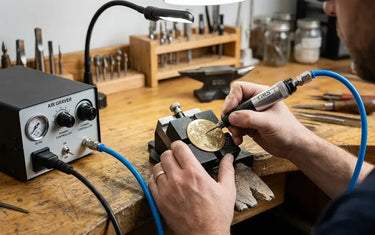
Manual push gravers cause severe hand fatigue and risky slips, while rotary micromotors lack precision impact control. A modern pneumatic engraving machine bridges this gap—delivering effortless deep-relief cutting power alongside microscope-level finesse for delicate stone setting. Here is how to choose the perfect system for your bench.
I. Key Technical Parameters: 4 Metrics That Determine Performance

Understanding the core engineering specifications behind pneumatic systems ensures you invest in equipment that aligns with your specific engraving style.
1. Stroke Frequency (SPM – Strokes Per Minute)
The pulse frequency dictates how cleanly the tool shears through metal:
- High Frequency (4,000–8,000+ SPM): Best for ultra-fine micro-pavé setting, bead raising, bright-cutting, and delicate bulino shading. The rapid pulses create a continuous, fluid cutting feel that prevents the tool from stalling or catching.
- Low to Medium Frequency (400–3,000 SPM): Delivers individual, high-energy impact strokes. This frequency range is essential for deep background metal removal, heavy weapon/knife engraving, and working with tough alloys.
2. Air Supply & Power Source: External Air vs. Compressor-Free
- External Air Drive (0–60 PSI / 0–8 kgf/cm²): Uses workshop compressed air to actuate precision spool valves. These systems offer linear modulation and low-pressure sensitivity, operating smoothly down to 2–5 PSI without valve stalling.
- Built-in Electromagnetic Pulse Generator (100% Compressor-Free): Generates mechanical pulses directly inside the console using electronic solenoids. This setup eliminates bulky air compressors, noisy tank cycling, and regular moisture maintenance.
3. Port Configurations & Multi-Functionality
- Single vs. Dual Handpiece Ports: Single-port units are compact and budget-friendly for focused tasks. Dual-port consoles let you keep two handpieces connected simultaneously (such as a heavy roughing handpiece and a lightweight shading tool), switching between them instantly via a front-panel toggle.
- Auxiliary (AUX) Air Ports: Dedicated ports that power secondary tools like chip blowers or pneumatic marking pens without drawing power from your primary engraving line.
- 2-in-1 Multi-Function Systems: Advanced units integrate both a pneumatic impact driver and an independent 0–35,000 RPM rotary micromotor, consolidating stone setting, drilling, burs, and polishing into a single benchtop footprint.
4. Modulation & Throttle Control
- Linear Foot Pedals: Pneumatic or electronic foot switches provide graduated throttle control, leaving both hands free to position work under the microscope.
- Panel-Based BIAS Adjustment: Fine-tunes initial air bleed and throttle sensitivity, allowing you to dial in the exact activation point of the handpiece piston to match personal touch and tool weight.
II. Model Selection Based on Application Scenarios
Match your primary metalworking and jewelry tasks to the right power configurations and tooling setups:
|
Application Scenario |
Material & Process Focus |
Recommended Stroke & Power Configuration |
Handpiece & Setup Recommendations |
|
Gem Micro-Setting & Beading |
18K gold, platinum, prong work, channel setting, millgrain, micro-pavé |
High-frequency light impact (>5,000 SPM), smooth low-PSI control |
Ultra-lightweight aluminum handpiece, precision Quick-Change (QC) collets |
|
Firearm & Knife Engraving |
Stainless steel, Damascus steel, titanium, deep relief carving |
Low-to-mid SPM, heavy impact piston, wide pressure range (up to 60 PSI) |
Heavy-duty stainless steel or tungsten-weighted handle (4g/6g piston), large collets |
|
Lettering & Traditional Scrollwork |
Sterling silver, brass, copper, trophy plates, Western bright-cut |
Full-range adjustable SPM (400–8,000 SPM), linear pedal response |
Standard balanced handle, assorted graver geometries (flat, onglette, round) |
|
Comprehensive Jewelry Studio |
Multi-step production: carving, stone setting, clean-up, final polishing |
Dual-port console or 2-in-1 multifunctional unit with wide dynamic range |
Dual-handpiece setup or combined Pneumatic + 35,000 RPM Micromotor station |
II. Workbench Integration & Air Supply Setup

A reliable pneumatic engraving workstation relies on clean air and an organized bench.
Dual-Track Air Supply Options
- External Air Supply: Requires an oil-free, ultra-silent air compressor. Look for a unit with an operating noise level under 55 dB, a tank volume of at least 20 liters, and a delivery rate of 0.5–1.5 CFM at 45 PSI.
- Compressor-Free Pulse Units: Truly plug-and-play systems running on standard 100–240V power. These are ideal for apartment studios, retail jewelry kiosks, trade shows, and compact benches where floor space is limited.
Air Supply Purification (Moisture Filtration)
For external air systems, clean air is critical. Moisture and airborne debris entering the console will corrode precision-machined pistons and cause internal valves to seize.
Always install a two-stage filtration system comprising a primary water-vapor separator paired with a 5-micron coalescing drying filter and a manual push-drain valve.
Workstation Ergonomics & Line Management
- Mount the console or pressure regulator gauge at eye level so you can check system pressure without looking away from your work.
- Route flexible polyurethane air hoses using overhead spring-balanced suspension arms or bench-edge clips to eliminate line drag on the handpiece.
IV. Handpiece Systems and Accessory Compatibility
The handpiece is your direct tactile interface with the workpiece; its balance and ergonomics directly influence line quality and hand comfort.
- Lightweight Aluminum Handpieces (~50–80g): Provide maximum feedback and fingertip control for micro-stone setting and delicate shading.
- Heavy Stainless Steel Handpieces (~120–180g): Leverage added mass to absorb recoil and drive deep cuts into tough alloys with less user exertion.
- Interchangeable Internal Pistons: Premium handpieces feature interchangeable internal pistons (such as 4g and 6g weights), letting you adjust strike force without changing the handpiece body.
- Quick-Change (QC) Collet Systems: Verify that the tool uses standard quick-change collet systems accommodating standard shank sizes, including 1/8" (3.175 mm), 3/32" (2.35 mm), and square shank graver blanks.
- Sharpening Geometry Alignment: Pneumatic engraving efficiency depends entirely on exact cutting face and heel angles. Ensure your bench includes a dual-angle sharpening fixture paired with diamond sharpening wheels to maintain consistent cutting geometry.
V. Top Recommendations: Choosing the Right Machine
To streamline your selection, here are three proven configurations tailored for different workshop requirements.
1. Minimalist Pneumatic Starter Setup: Pneumatic Engraver with Foot Pedal Kit
An ultra-compact, direct-drive system engineered for clean, functional performance without the bulk of a standalone console box.

-
Key Specifications:
- Gross Weight: 2.2 kg (4.85 lbs)
- Foot Switch: Heavy-duty Airtac FV320 mechanical valve (0 to 8 kgf/cm² / 0 to 114 PSI)
- Filtration: In-line precision regulator with integrated moisture filter and manual drain
- Handpiece: Ergonomic dual-tone contoured impact barrel
- Standout Performance: The industrial-grade Airtac FV320 pedal delivers linear, mechanical air throttling directly from your workshop compressor. An integrated filter regulator cleans incoming air, while the ergonomic handpiece ensures steady handling.
- Best Suited For: Jewelers with an under-bench air line seeking a minimalist, clutter-free desktop, or artisans needing a portable setup for workshops and basic bright-cutting.
2. Workshop Workhorse: GraverMax G8 (Model: HH-G01)
A durable, dual-port pneumatic console built for demanding daily production schedules in professional jewelry studios.

-
Key Specifications:
- Housing: Seamless one-time stamped, thickened stainless steel chassis (9.5 kg)
- Speed Range: 400 to 8,000 SPM (Strokes Per Minute)
- Air Pressure: 0 to 60 PSI (0 to 0.4 MPa / 0 to 4 kg/cm²)
- Ports: Dual handpiece quick-connect ports + dedicated rear AUX line
- Standout Performance: The GraverMax G8 allows you to connect two impact handpieces simultaneously and toggle between them on the fly. The front panel features a 400–8,000 SPM speed adjustment dial, a calibrated 0–60 PSI pressure gauge, and a dedicated BIAS sensitivity control to fine-tune throttle response.
- Best Suited For: Commercial jewelry manufacturing studios and custom engravers switching between deep background clearing and pavé bead raising.
3. Flagship Compressor-Free 2-in-1: HH-AT02 ARTGRAVER II
An all-in-one workstation that eliminates the need for an external compressor while combining pneumatic impact carving with high-speed rotary finishing.

-
Key Specifications:
- Power System: 100% compressor-free internal pulse generator (160W, 100–240V)
- Micromotor: High-torque 0 to 35,000 RPM rotary handpiece
- Modes: 3-way selector knob for G (Engraving), P (Polishing), and D (Drilling)
- Customization: Includes 4g and 6g internal weighted pistons
- Standout Performance: Operates completely without an external air compressor, generating balanced impact pulses with its internal 160W drive. It features an independent 35,000 RPM rotary micromotor handpiece, a clear digital LED display, and an intuitive 3-way mode switch for seamless workflow transitions.
- Best Suited For: Home studios, mall-based jewelers, and cleanroom microscope workstations requiring silent operation and an all-in-one setup for stone setting, drilling, and micro-polishing.
VI. Common Purchasing Pitfalls and How to Avoid Them
- Pitfall 1: Prioritizing Maximum Power Over Low-Pressure Linearity.
- Aggressive impact force matters for heavy metal removal, but precision stone setting demands smooth operation at ultra-low pressures (2–5 PSI). Ensure the system provides linear, progressive throttle control without sudden bursts that can crack stones.
- Pitfall 2: Neglecting Incoming Air Quality.
- Standard garage air compressors produce condensation and oil mist. Connecting raw air lines directly to a pneumatic engraving console will quickly foul internal spool valves. Always install a dedicated coalescing filter and water trap.
- Pitfall 3: Overlooking Collet and Tooling Ecosystems.
- A low-cost machine becomes expensive if it uses proprietary, non-standard collets. Stick to platforms compatible with standard 1/8", 3/32", and square-shank graver blanks to keep replacement and specialty tool costs manageable.
Conclusion
Finding the ideal pneumatic engraving machine comes down to matching your workspace setup with your daily production demands:
- For Minimalist & Portable Setups with Existing Air Supply: Choose the Pneumatic Engraver with Foot Pedal Kit for an ultra-compact, clutter-free bench that connects directly to your current air line.
- For High-Volume Professional Workshops: The GraverMax G8 (HH-G01) is the definitive workhorse, delivering heavy-duty stability, a wide 400–8,000 SPM dynamic range, and dual-handpiece capability for rapid multi-tool workflows.
- For Quiet Studios & Workspaces Without Compressors: The HH-AT02 ARTGRAVER II provides an all-in-one, compressor-free solution combining quiet pulse impact carving with an integrated 35,000 RPM rotary micromotor.
Ready to upgrade your jewelry bench with a dependable, professional pneumatic engraving system? Explore the complete collection of commercial-grade pneumatic engraving machines, ergonomic handpieces, and precision stone-setting accessories at LuxgoldTools to build a workstation tailored to your craft.
