
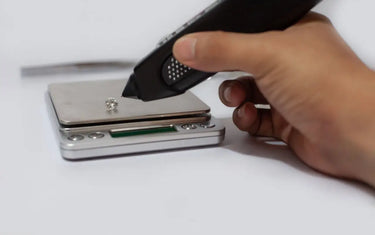
Mistaking moissanite for a natural diamond can ruin high-value deals, damage your reputation, and lead to costly intake errors. Because silicon carbide mimics diamond properties so closely, basic single-function selectors frequently trigger false positives. Choosing a reliable moissanite tester is essential for protecting your margins with precise, repeatable accuracy under daily workshop use.
I. Look at the Testing Principle: Dual Thermal and Electrical Conductivity

-
Single-Thermal Limits: Why Standard Selector Pens Fail
- Thermal Mirroring: Most entry-level diamond selectors rely strictly on thermal conductivity to identify gemstones. While a basic thermal pen easily weeds out cubic zirconia (CZ) or glass, it fails completely when faced with synthetic moissanite.
- Identical Heat Transfer Rate: Silicon carbide shares an almost identical thermal expansion and heat transfer rate with natural diamond (k ≈ 490–2300 W/m·K), meaning a thermal-only device will read moissanite as a genuine diamond every single time.
-
Dual-Technology Solution: Combining Thermal and Electrical Sensors
- Exploiting Electrical Differences: To achieve 100% accurate differentiation, you must choose a multi-tester equipped with both thermal and electrical conductivity detection (or photoelectric reflectance technology).
- Dual-Property Verification: While moissanite mimics diamond thermally, it possesses slight semiconductor electrical conductivity that natural diamond lacks. A dual-technology gemstone tester checks both physical properties simultaneously, instantly spotting synthetic moissanite without false positives.
II. Look at the Probe Design: Precision for Micro-Pave and Small Diamonds

-
Ultra-Fine Tip Diameter: Reaching Small and Pave-Set Stones
- Physical Contact Limits: The physical size of the probe tip dictates what you can actually test. If a probe tip is too thick, it cannot make clean contact with micro-pave settings, channel-set stones, or melee diamonds below 0.05 carats.
- Slippage and False Readings: Instead of touching the gem's table, a bulky probe slips and contacts the metal prongs, ruining the reading. Opting for sub-0.6mm micro-tips ensures direct contact with tiny stone facets.
-
Micro-Spring Cushioning: Stabilizing Pressure and Protecting Tips
- Ensures Consistent Surface Contact: A high-quality moissanite diamond tester uses a micro-spring loaded probe mechanism that automatically compensates for varying hand pressure, maintaining steady signal transfer on uneven facets.
- Protects the Device and Stone: The retractable mechanism prevents the fine tip from bending or snapping under heavy pressure while protecting delicate gemstone mountings from physical scratches.
III. Look at Anti-Interference Features: Metal Alerts and Auto-Calibration

-
Instant Metal Alert: Preventing False Metal-Conductivity Signals
- Accidental Metal Contact: When testing densely set jewelry or intricate vintage mountings, accidentally touching a gold, platinum, or silver setting with the probe tip is bound to happen.
- Audible & Visual Safeguards: Without anti-interference safeguards, the device reads the metal's high electrical conductivity as a false signal. A reliable portable moissanite tester features an instant Metal Alert system that emits a distinct beep or visual red signal the second metal is touched, preventing false readouts.
-
Temperature Compensation: Maintaining Accuracy Across Environments
- Ambient Sensitivity: Internal test circuitry is highly sensitive to ambient temperature changes. Without automatic compensation, hot summer shop environments, cold winter intake rooms, or internal circuit heating during continuous testing cause calibration drift.
- Built-In Auto-Calibration: Opt for models with built-in automatic calibration and thermal compensation to ensure identical accuracy regardless of room temperature or daily workload.
IV. Look at Usage Scenarios: Selection Recommendations Based on Verification Needs
Matching the right tool to your specific operational volume prevents bottlenecks and unnecessary equipment wear:
|
Business Scenario |
Key Priorities |
Recommended Selection |
|
Pawnshops & Bulk Purchasing |
Zero false positives, rapid response, strong anti-interference |
High-sensitivity dual-test instrument (thermal & electrical conductivity) with metal-contact alerts and ultra-fast recovery times |
|
Daily Counter Verification & Transaction Review |
Ease of use, intuitive display, portability |
Integrated diamond and moissanite tester with both audio and visual LED alerts |
|
Fine Settings & Small Diamond Screening |
Ability to test tiny stones, high durability |
Model equipped with an ultra-fine (sub-0.6mm) retractable probe and reinforced internal circuitry |
V. Look at Warranty & After-Sales Support: Protection Against Device Failure
-
Wearable Part Replacement
- Consumable Probe Tips: The delicate probe tip on any gems tester is a high-frequency consumable subject to natural friction wear over time.
- Modular Maintenance: Before buying, verify whether the manufacturer offers individually replaceable probes. Devices with permanently sealed probe assemblies force you to scrap the entire unit when the tip wears down, driving up long-term operational costs.
-
Warranty & Technical Support
- Backed Reliability: Precision testing tools require backed reliability. Choose established equipment vendors that offer clear warranty terms, stocked replacement tips, and accessible technical service.
- Uninterrupted Operations: Having dependable support ensures your intake desk never stays down for long during peak trading seasons.
Take the Next Step: Upgrade Your Authentication Tools Today
Ready to upgrade your bench with testing tools engineered for daily accuracy? Explore our full lineup of factory-calibrated Moissanite Testers and professional jewelry testing tools at LuxgoldTools.
