
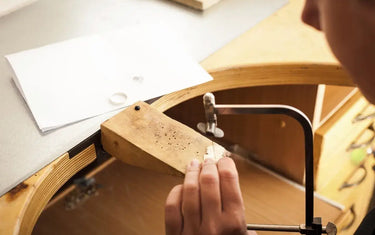
Frustrated with snapped saw blades and a sore wrist? It’s likely your saw frame, not your technique. There’s no single "perfect" tool—only the right one for the job. Read on to master throat depth, frame types, and tension mechanisms, and find the ultimate upgrade for your bench.
Key Factor 1: Choosing the Throat Depth
Throat depth determines the maximum distance you can reach into a sheet of metal to make a cut. Choosing the right size ensures your tool remains balanced while clearing the edges of your workpiece.
Comparison and Selection Matrix
|
Throat Depth |
Best Suited For |
Pros & Cons |
|
2 Inch (50-60mm) |
Intricate piercing, micro-setting prep, small ring making |
Extremely lightweight and highly controllable; unsuitable for large sheets |
|
3 Inch (75-80mm) |
"Golden Size" (Industry Standard), versatile everyday work |
Best balance; the top choice for a standard bench tool |
|
4-5 Inch (100-125mm) |
Large pendants, bangles, extensive cutting on silverware |
Wide cutting range; slightly heavier with a forward-leaning center of gravity |
Key Factor 2: Adjustable vs. Fixed Frames
The structural design of your jewelers saw frame impacts both your overhead costs and the rigidity of your stroke.

Adjustable Saw Frames
- Features: The frame length can be adjusted by sliding the back section up or down along a rigid spine.
- Advantages: This design maximizes material usage. When expensive, ultra-fine blades (such as size 4/0 or 6/0) snap, you don't have to throw them away. You can simply shorten the frame to clamp and reuse the remaining broken blade, saving your workshop significant money on consumables over time.
Fixed Saw Frames
- Features: One-piece construction with a rigid, non-adjustable length designed specifically for standard 130mm piercing blades.
- Advantages: Excellent frame rigidity ensures the frame never retracts or slips during heavy-duty cutting. There are no thumb screws along the spine that can back out under pressure.
Key Factor 3: Tensioning and Clamping Mechanisms
How you secure your blade dictates how fast you can work, especially when executing complex, multi-hole fretwork.

Traditional Thumb Screws
This classic, time-tested design relies on manual wing nuts or thumb screws to pinch the blade in place. While highly reliable and cost-effective, frequent blade changes—such as when performing intricate piercing work that requires constantly unclamping and threading the blade through internal drill holes—can cause significant finger fatigue and thumb soreness by the end of the day.
Quick-Release / Lever Tension
A standard feature on modern, high-end saw frames, this mechanism replaces manual twisting with a mechanical lever. A simple flip of the lever instantly releases or restores precise tension. This vastly improves efficiency for tasks requiring frequent blade threading, allowing you to move from one interior cut to the next in seconds.
Ergonomics and Materials: Weight Affects Fatigue
When fabricating custom jewelry, you might hold your saw for hours at a time. The materials on your workbench dictate your physical comfort.

- Frame Material: Traditional carbon steel frames offer a comforting weight and natural momentum that helps guide straight cuts through thick gold or silver plate. Conversely, modern aerospace-grade aluminum or titanium alloy frames offer an ultra-lightweight alternative. These high-tech metals dramatically reduce wrist strain during prolonged, intensive piercing sessions.
- Handle Design: Look for premium, non-slip wooden handles or ergonomic rubber grips. A properly shaped handle ensures a stable, controlled hold, even when your hands become sweaty under intense studio lighting.
The Bench Jeweler's Ecosystem
Maintining an efficient studio goes beyond hand tools. Just as a perfectly tensioned saw frame ensures clean metal wire profiles, a high-precision jewelry scale ensures your precious metal scrap, casting grains, and finished settings are accounted for down to the milligram. Precision in cutting matches precision in weight.
Expert Tip: How to Test Saw Frame Tension
An improperly tensioned blade is the number one cause of premature breakage. To test your setup, install the blade with the teeth facing down and out, then pluck it with your fingernail like a guitar string:
- A crisp "ping" (high-pitched sound): Indicates perfect, resonant tension.
- A dull "thud": Means the blade is too loose. It will buckle, wander, or snap the moment it binds in the metal.
- No audible tone (choked sound): The tension is excessive. The blade is stretched to its absolute limit and will snap under the slightest twisting force.
Conclusion
For beginners on a budget, a 3-inch adjustable German-style carbon steel saw frame remains the top recommendation for learning proper muscle memory. Professional studios prioritizing daily efficiency, rapid blade threading, and minimal physical fatigue should invest in premium aluminum or titanium alloy frames featuring integrated quick-release levers.
Ready to upgrade your bench setup? Explore the professional selection at LuxgoldTools, where we supply jewelers worldwide with high-rigidity saw frames, precision clamping tools, and workshop essentials engineered for flawless fabrication.
