
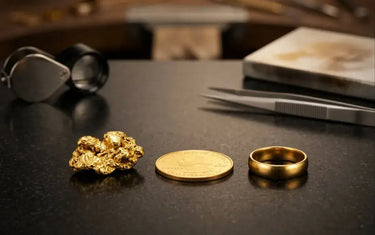
Launching a gold buyback business or entering the jewelry trade comes with one major hurdle: avoiding costly counterfeits. Choosing between cheap, unreliable acid kits and overly expensive gear can easily trap beginner buyers. Here is a clear 5-Step Decision Process to help you pick the right, cost-effective gold tester without overspending or taking unnecessary risks.
Step 1: Identify Your Testing Scenario & Material Types
Before evaluating technical specifications or comparing brands, you must clearly define what you are testing and where those tests take place. As a beginner, your daily inventory will dictate the exact type of equipment you need.
1. Sample Form Factor & Its Technical Impact on Equipment Selection

- Solid Bullion & Coins (Gold Bars, Maple Leafs, Krugerrands): Because solid bars have standard dimensions and no internal hollow voids, they are best verified using Specific Gravity (Hydrostatic) Balances. A simple surface tester isn't enough here, as it cannot detect dense tungsten cores hidden deep inside a gold bar.
- Finished & Intricate Jewelry (Rings, Chains, Detailed Crafts): Intricate designs, solder seams, and varying Karat purities make physical volume and density measurements nearly impossible. For these items, you must choose an Electronic Conductivity Tester with a fine-point probe that can safely touch small surface areas without damage.
- Hollow Items & Gemstone-Set Jewelry: Gemstones add unaccounted weight, and hollow interiors trap air, completely disrupting specific gravity water testing. If your inventory frequently includes these, avoid relying solely on density scales and choose a surface electromagnetic or electronic tester.
- Unrefined Scrap & Melted Gold: Scrap gold often has uneven surface purity or residual plating. Evaluating scrap requires testing methods that assess deeper metal layers or give a broader alloy reading rather than relying on a shallow surface probe.
2. Operational Environment & Hardware Requirements

- Mobile Operations (On-Site Buybacks, Trade Shows, Estate Sales): If you plan to meet clients on the go, your primary requirement is physical portability. Look for battery-operated, compact electronic testers that fit into a carrying case and do not require delicate fluid balance setups or stable, vibration-free shop tables.
- Fixed Countertop Locations (Pawnshops, Retail Jewelers): If you operate from a counter, portability is secondary. You should prioritize desktop stability, larger digital readouts, and visually clear displays. A counter-mounted setup builds instant visual trust with walk-in customers during the evaluation process.

3. Testing Frequency & Speed Considerations
- High-Volume Walk-In Traffic: If you evaluate dozens of items daily, every second counts. You need a rapid electronic scanner that gives definitive pass/fail or Karat readings within 3 to 5 seconds to keep your workflow moving.
- Low-Frequency, High-Value Transactions: If you handle occasional high-dollar bullion purchases, speed is secondary to multi-angle proof. You can afford a slower, multi-step verificastion process (e.g., combining specific gravity testing with magnetic and dimensional checks) where thorough risk elimination takes priority over testing speed.
Step 2: Align Your Beginner Budget with Risk Tolerance

As a beginner, your equipment budget should protect you from financial ruin without draining all your working capital. Rather than looking at industrial-grade machinery, focus on realistic budget tiers for entry-level operations:
- Entry-Level / Ultra-Low Budget ($30 – $200): Consists of basic acid scratch sets, neodymium magnets, and basic digital scales. While tempting for beginners on a tight budget, relying solely on acid scratch tests carries high operational risk for commercial transactions due to surface damage and operator error.
- Startup Commercial Budget ($200 – $1,500): The ideal sweet spot for beginners. This budget tier buys non-destructive electronic conductivity testers and high-precision specific gravity balances. These tools deliver commercial-grade accuracy, build customer confidence, and keep your initial startup costs manageable.
(Note: Industrial XRF spectrometers costing $10,000 to $30,000+ are designed for large refineries and commercial assay labs—they are entirely unnecessary for beginners starting a retail or buyback operation.)
Step 3: Match Technology to Beginner Selection Criteria
Understanding how basic testing technologies work helps you pick the right tool for your specific startup needs without overpaying for features you won't use.
1. Electronic / Conductivity Testers (Best Overall for Beginner Jewelry Buyers)

- How They Work: These devices measure surface electrical conductivity and electromagnetic response to determine metal purity instantly.
- When to Pick: Ideal for finished jewelry, chains, and rings where you need immediate, non-destructive results without using messy chemicals. They are lightweight, battery-operated, and require virtually no technical training.
2. Hydrostatic / Density Balances (Best for Beginner Bullion Buyers)

- How They Work: Using Archimedes' principle, these systems measure a sample's dry weight against its weight submerged in liquid to calculate exact density.
- When to Pick: Essential if your beginner operation focuses primarily on solid bullion, cast ingots, or raw gold nuggets. Specific gravity testing evaluates the entire mass rather than just the surface layer.
3. Acid Test Kits / Touchstone Sets (Use Only as Emergency Backup)

- How They Work: The item is scratched across a slate touchstone, and nitric acid solutions are applied to observe chemical reactions across Karat thresholds.
- When to Pick: Best reserved as a low-cost secondary backup. Because acid testing requires filing or scratching the item and involves corrosive chemicals, using it as your primary tool can alienate customers and ruin fine jewelry.
Step 4: Verify 4 Critical Reliability Factors
Before purchasing a specific model, evaluate it against these four beginner-essential performance metrics:
- Non-Destructive Integrity: As a beginner establishing a reputation, damaging a client's estate jewelry with scratches or acid marks can ruin your business. Ensure your primary testing device uses surface-safe electronic probes or liquid-free measurement methods.
- Anti-Fraud & Core Detection: Advanced counterfeits use heavy gold plating (20–50 microns) over base metals, or insert dense tungsten cores inside gold bars. Verify that your equipment or testing methodology can detect deep-layer discrepancies beneath surface plating.
- Simple Calibration Protocols: Electronic instruments drift over time due to temperature changes and battery levels. Look for testers designed for beginners that include standard reference calibration samples (such as a dedicated test disc) and feature a clear, one-touch calibration process.
- Vendor Support & Warranty Coverage: Avoid cheap, unbranded online tools sold without technical documentation. Choose established equipment providers that offer comprehensive warranties, clear Karat conversion charts, and accessible customer service to guide you as you learn.
Step 5: Build a Multi-Tool Verification System for Beginners
Relying on a single testing method can create dangerous blind spots for a beginner. A surface tester might miss a tungsten core inside a thick bar, while a density scale cannot accurately measure a hollow gold chain or stone-set ring.
Smart beginners use a simple, low-cost multi-tool setup:
- Core Gold Tester (Primary Tool): An electronic conductivity tester or a specific gravity balance handles roughly 90% of your daily testing volume cleanly and quickly.
- Essential Tool #1 (Neodymium Magnet): A high-grade N52 rare-earth magnet ($10–$20) quickly identifies iron, nickel, or steel cores hidden underneath gold plating before you run a full test.
- Essential Tool #2 (Precision Digital Scale & Vernier Calipers): Verifying an item's exact weight against standard physical dimensions immediately flags fake bullion coins and bars.
Starting Your Business with Confidence
As a beginner, picking a reliable gold tester comes down to understanding your daily inventory, avoiding damaging chemical methods, and protecting your capital with a layered testing process. By skipping under-powered hobby kits and avoiding unnecessary industrial machinery, you can equip your workbench with commercial-grade tools that build immediate customer trust.
If you are ready to equip your workbench or mobile kit with professional-grade testing gear, explore the curated collection of Gold Testers and testing accessories at LuxgoldTools. From beginner-friendly portable electronic testers to high-precision specific gravity balances, LuxgoldTools provides reliable equipment backed by warranty support and industry expertise to help you buy and trade with confidence.
