
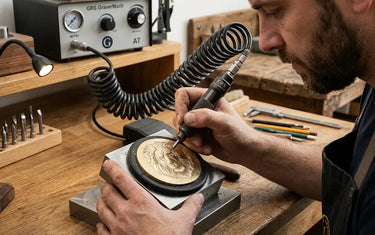
Transitioning from traditional push gravers to an air-assisted engraving system transforms bench speed and precision. However, choosing the right pneumatic engraving machine requires looking beyond raw specs to evaluate real-world control, air supply needs, and tool compatibility.
Evaluation Criterion 1: Tool Control Precision and Response Linearity

In hand engraving and pavé setting, raw power is meaningless without micro-metered control. A superior machine delivers progressive, linear throttle response where the cutting tip moves predictably along the metal without sudden spikes in force.
Low-End Sensitivity and Valve Deadband
The true test of any pneumatic console is its performance at the absolute bottom of the throttle curve.
- Throttle Deadband: Inferior mechanical or spool valves often exhibit a noticeable lag—requiring moderate pedal travel before breaking static friction, only to release a sudden burst of pressurized air.
- Bench Consequence: In micro-prong raising or delicate shading under a microscope, an unexpected surge will jump the graver out of the cut, shearing prongs or scratching polished gallery surfaces.
- Evaluation Standard: Test whether the handpiece can deliver ultra-light, single-stroke taps with minimal pedal depression. The piston should cycle smoothly at sub-PSI threshold pressures without hesitation.
SPM (Strokes Per Minute) Dynamic Range
A wide operating window dictates the machine's versatility across varying metal densities:
- Low-Frequency Range (400–1,500 SPM): Essential for deep relief carving, background clearing, bead bezel rolling, and working unannealed tool steels. This range delivers distinct, heavy impacts with long dwell times to shift dense stock cleanly.
- High-Frequency Range (4,000–8,000+ SPM): Creates an ultra-dense, almost fluid cutting frequency. This is critical for bright-cutting soft high-karat golds, silver filigree, and executing microscopic bulino dotting without leaving visible serrations along curved cuts.
Recoil and Vibration Dampening
Continuous vibration transfers mechanical stress directly into the small joints of the hand and wrist.
- Look for handpieces engineered with tuned internal dampening chambers or counterbalanced internal strike masses.
- A well-balanced tool directs kinetic energy axially into the graver shank while absorbing radial housing vibration, preventing hand fatigue during 8-hour bench days and eliminating tool wander.
Evaluation Criterion 2: Air Supply Method and Environmental Suitability

The machine's drive architecture dictates the supporting infrastructure required at your workstation. Balancing performance against space and noise constraints is essential.
All-in-One Models with Built-in Pumps
- Mechanical Setup: These consoles house an internal pulse-generating diaphragm or rotary micro-pump, eliminating external tanks and high-pressure supply lines.
- Best Applications: Ideal for retail repair counters, home-based studios, and compact jewelry benches where noise must remain below conversational levels and footprint is at a premium.
- Operational Limits: Integrated pumps operate at fixed displacement volumes. They excel at light-to-medium jewelry engraving and gemstone setting, but lack the sustained volume and impact mass required for deep single-pass steel carving or heavy punch work.
External Air Compressor Systems
- Mechanical Setup: The console acts as a precision distributor, regulating compressed air fed from an external tank (typically requiring 30 to 60 PSI supply pressure).
- Best Applications: High-volume commercial studios, master engravers, and workshops cutting difficult alloys like 316L stainless steel, titanium, or Damascus steel.
- Filtration Infrastructure: External systems require a two-stage coalescing filter-regulator with an auto-drain mechanism. Unfiltered air containing airborne ambient humidity or compressor oil aerosol will wash away internal spool lubricants and cause sticky piston seizures inside the handpiece bore.
Evaluation Criterion 3: Handpiece and Clamping System Compatibility

Your engraving console is an engine; the handpiece and tooling system are what interface with the workpiece. Compatibility dictates both workflow speed and long-term operating costs.
Channel Count and Port Switching (Single vs. Dual Ports)
- Single-Port Consoles: Require manual disconnection of air lines or quick-disconnect couplers whenever switching between tasks, which interrupts workflow during multi-step jobs.
- Dual-Port Systems: Allow two handpieces to remain connected and independently dialed into specific pressure parameters simultaneously. A front-panel rotary switch enables instantaneous transitions between a fine-shading tool and a heavy background hammer, eliminating the need to re-bleed or re-adjust air regulators mid-project.
Collet and Quick-Change (QC) Chuck Standards
- Tool Swapping Efficiency: Inspect the chuck nose. Modern workshops rely on hardened steel Quick-Change (QC) collet systems that let you snap pre-sharpened gravers in and out in seconds without using set-screw wrenches.
- Tool Shank Geometry: Ensure collets accept standard 1/8" (3.17 mm) round shanks, 3/32" micro-stems, and standard square blanks (such as GlenSteel, C-Max, or High-Speed Steel blanks). Avoid closed, proprietary chuck designs that restrict you to pre-assembled, single-vendor graver assemblies.
Handpiece Piston and Weight Configurations
Assess whether the console supports a modular range of handpieces:
- Lightweight Micro-Handpieces: Fitted with lightweight steel or titanium pistons for high-speed micro-setting.
- Heavy Magnum Handpieces: Fitted with dense tungsten carbide pistons that generate maximum striking inertia at lower frequencies.
Evaluation Criterion 4: Durability & Maintenance Requirements

Pneumatic tools are exposed to rapid mechanical cycling, making mechanical tolerances and component accessibility vital to your purchase decision.
Valve Architecture: Self-Lubricating vs. Oil-Bath
- Oil-Free Spool Assemblies: High-precision ceramic or Teflon-coated rotary valves run entirely dry. They require zero regular lubrication and eliminate the risk of oil mist spraying onto customer jewelry or contaminating stone settings.
- Lubricated Assemblies: Traditional valves require periodic drops of ultra-light synthetic pneumatic oil. While durable, they require vigilant moisture trapping to prevent the oil from forming a sticky sludge inside the handpiece cylinder.
Wear Components and Field Serviceability
- Continuous rapid pulsing subjects O-rings, internal return springs, and polyurethane air lines to mechanical wear.
- Confirm that the manufacturer uses standard metric or imperial O-ring profiles and modular spring assemblies rather than sealed, non-serviceable cartridges. You should be able to disassemble the handpiece, clean the bore with isopropyl alcohol, replace an O-ring, and reassemble it in under five minutes.
Manifold and Housing Build Materials
- Check the internal plumbing: consoles with CNC-machined brass, bronze, or anodized aircraft aluminum manifolds withstand repetitive pressure cycling without stress cracking.
- Injection-molded plastic air splitters and low-grade push-fit connectors are prone to micro-leaks over time, leading to pressure fluctuations and erratic piston cycling.
Core Parameter Evaluation & Selection Comparison
|
Evaluation Dimension |
Entry-Level & Boutique Jewelers |
Professional Setters & Studios |
Gunsmiths & Hard Metal Engravers |
|
Recommended Air Source |
Built-in micro pump (all-in-one) |
Silent external compressor (0.5–1 HP) + coalescing filter |
High-output compressor with 5+ gallon storage tank |
|
Console Port Configuration |
Single-port (manual swap) |
Dual-port (instant toggle) |
Single heavy-duty or multi-port |
|
Operating Frequency Target |
4,000–8,000 SPM (smooth, fine cuts) |
800–7,500 SPM (wide-band versatility) |
400–2,500 SPM (high-energy single impacts) |
|
Piston Material Profile |
Lightweight hardened steel / alloy |
Standard steel + micro-piston sets |
Heavyweight tungsten carbide piston |
|
Tool Holding Mechanism |
Standard 1/8" QC quick-change |
Standard QC + micro-shank holders |
Heavy-duty QC or locking set-screw chuck |
Final Purchase Decision Checklist
Before committing to a specific pneumatic engraving platform, run through this practical pre-purchase verification:
- Material and Task Focus: Are you primarily setting gemstones in gold, platinum, and silver (demanding high SPM and low starting threshold), or cutting deep scrollwork into hardened steel receivers and knife bolsters (demanding high piston mass and low SPM)?
- True Out-of-the-Box Package Contents: Does the listed price cover the control console alone, or does it include the precision foot pedal, primary handpiece, tubing kit, and filter-regulator?
- Graver Inventory Integration: Will the machine's handpiece chuck accept your current stock of hand gravers and sharpening fixtures, or will you need to purchase new adaptersBench Ergonomics and Setup: Does your studio layout support routing an external high-pressure air line and running a compressor, or do space limitations favor a dedicated desktop all-in-one console?
Equipping your bench with the right pneumatic engraving machine reduces hand strain, accelerates setting speed, and delivers the crisp, mirror-bright cuts that define master-level craftsmanship. Explore the full range of professional pneumatic power units, precision handpieces, and bench accessories at LuxgoldTools to find the exact setup tailored to your production needs.
