
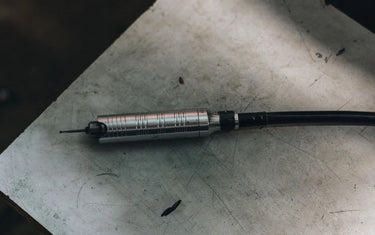
A dependable rotary setup forms the backbone of any goldsmithing workstation, transforming demanding stone setting, carving, and metal finishing into fluid bench operations. Finding the right flex shaft rotary tool for jewelers means balancing steady low-speed muscle against sensitive foot control and low runout.
I. 5 Key Criteria for Jewelers When Choosing a Flex Shaft Rotary Tool
Selecting a flexible shaft drive requires examining how electrical and mechanical components handle fine bench tasks. Look beyond peak rotations per minute to prioritize real-world metalworking control.

1. Low-End Torque
When setting stones, cutting delicate seats with hart burs, or drilling tiny guide holes, you need continuous rotational power between 500 and 2,000 RPM. Inexpensive motors often stall the moment a bur touches gold or silver, or they jerk unpredictably when you apply light downward feed. A professional universal motor maintains constant rotational force at crawl speeds, preventing gouged bezels and snapped drill bits.
2. Dual-Direction Reversibility
Bidirectional rotation delivers practical daily benefits across several bench operations:
- Ambidextrous Ergonomics: Allows both left-handed and right-handed artisans to direct swarf and airborne dust away from their line of sight.
- Safe Tool Extraction: Reversing the motor backs twisted micro-drills out of deep holes in platinum or silver without bending the bit or tearing precious metal.
- Consumable Life Extension: Running rotary brushes, rubber points, and miniature felt bobs in reverse cleans out packed debris and dresses abrasive surfaces, doubling the service life of accessories.
3. Foot Pedal Linearity and Ergonomic Design
Speed control should respond smoothly across the entire sweep of your foot. Low-grade foot rheostats jump abruptly from zero to several thousand RPM, causing cutting burs to skate across delicate metal surfaces. A heavy-duty, wide-profile foot control with solid-state circuitry provides continuous speed modulation without dead zones. Anti-slip diamond tread prevents foot fatigue and keeps the pedal firmly planted during long carving sessions.
4. Handpiece Chuck Capacity and Concentricity
Concentricity defines accuracy at the bench. Substandard handpieces introduce runout that snaps 0.5 mm to 1.0 mm twist drills and chatters during pavé work.
- Geared Chucks: Provide maximum versatility by gripping varied shank sizes.
- Quick-Change Mechanisms: Lock standard micro-shanks instantly for repetitive stone setting and multi-stage sanding.
5. Voltage Compatibility
Motors wound for 115V North American electrical outlets will overheat and burn out immediately if connected to a 230V European or international supply without a step-down transformer. Always confirm studio line voltage and source a machine wound specifically for your region's grid (such as dedicated 230V international setups).
II. Comparative Buying Guide for Core Flagship Models
Selecting the right machine depends on your production scale, workflow, and whether you prefer an all-in-one bundle or an adaptable, modular setup.
1. The Industry Gold Standard: Foredom K.8301 230V Set

Core Components: Combines a 1/6 HP ball-bearing M.SR hang-up motor, an extra-wide C.FCT solid-state foot control, a classic H.30 geared chuck handpiece, a 39-inch standard key-tip flexible drive cable, and a tube of specialized lubricant.
Performance Advantages: Delivers up to 18,000 RPM with smooth forward and reverse switching. All components arrive factory-matched for balanced torque delivery. The included H.30 handpiece features an adjustable 0 to 5/32″ (approx. 0–4 mm) chuck capacity operated by an HPCK-0 key, accommodating wide-ranging drill wire, mandrel, and bur sizes without separate collets.
Target Users & Use Cases: Ideal for jewelry students building a dedicated workspace, traditional bench jewelers, and craft studios needing an all-in-one bench setup.
2. Modular Studio Setup: Foredom M.SR-FCH-22 System

Core Configuration: Pairs the 1/6 HP dual-direction M.SR motor with an ergonomic C.FCH-2 foot control in an anti-slip diamond-pattern housing and a standard 39-inch key-tip shaft. This package excludes a handpiece.
Performance Advantages: Retains identical low-end torque, responsive motor reversibility, and international 230V grid compatibility. It spares you the expense of a general-purpose chuck if your workflow demands task-specific tooling, allowing you to invest directly in rapid-release or percussion handpieces.
Target Users & Use Cases: Production stone setters and experienced goldsmiths who already own standard chucks and plan to attach specialized units like the H.20 quick-change handpiece or H.15 hammer handpiece.
3. Cost-Effective Entry-Level Alternative: Generic 1/4 HP Hanging Rotary Tool
Core Configuration: Uses a generic 1/4 HP series-wound hang-up motor mounted on a cast-iron base, a stamped-steel or plastic foot pedal, and an H.30-style geared handpiece.
Performance Advantages: Keeps startup costs low, providing immediate out-of-the-box utility for gross metal removal, grinding down thick casting sprues, rough lapidary pre-forming, and general buffing.
Trade-Offs and Limitations: Foot pedals on budget clones often display stepped speed surges rather than smooth acceleration. Shaft vibration and noticeable chuck runout limit fine precision, increasing the risk of broken micro-drills or scratched mountings during stone setting.
Target Users & Use Cases: Metalworking beginners with strict budget constraints and craft hobbyists focused primarily on rough cleanup and occasional polishing.
Foredom® K.8301 230V Full Kit
Motor: 1/6 HP M.SR (Forward/Reverse, 18,000 RPM)
Included: H.30 Geared Chuck (0–4mm) + Solid-State C.FCT Pedal
The complete, ready-to-hang workshop benchmark. Perfect out-of-the-box balance for drilling, burring, shaping, and mirror polishing.
🟢 In Stock • 230V International • Ready to Ship
🛒 Check Price & Details (K.8301 Kit) →Foredom® M.SR-FCH-22 Motor & Pedal
Motor: 1/6 HP Reversible Ball-Bearing M.SR (230V)
Control: Ergonomic C.FCH-2 Foot Pedal + 39" Inner/Outer Shaft
Built for artisans who prefer choosing their own handpieces. Pair directly with an H.20 quick-change or H.15 hammer handpiece without paying for extra chucks.
🟢 In Stock • Genuine Foredom • Fast Dispatch
🛒 Check Price & Details (M.SR System) →III. Handpiece System: Precision-Matched Solutions
A hanging rotary tool derives its working dexterity from the handpiece attached to its flexible inner core. Choosing the right configuration prevents hand strain and streamlines complex jobs.
1. Classic Three-Jaw Geared Chuck Handpiece (Foredom H.30)

Specifications: Wide clamping range spanning 0 to 4 mm (0–5/32″) locked via the dedicated HPCK-0 chuck key.
Advantages: Unmatched accessory freedom. Holds tiny wire drills, odd-sized carving burs, unmounted finishing wheels, and oversized polishing mandrels securely without swapping internal collets.
Positioning: The primary general-purpose workhorse for rough grinding, drilling mounting holes, blending metal joints, and running broad polishing buffs.
2. Quick-Change Handpiece (Foredom H.20)

Specifications: Precision collet designed exclusively for standard 2.35 mm (3/32″) shank accessories.
Advantages: Actuating a quick-release quarter-turn hand lever ejects and locks accessories in a single second without a chuck key. Its slender, tapered grip sits comfortably like a technical pen.
Best For: Channel, prong, and pavé stone setting, as well as multi-step pre-polishing routines requiring constant swaps between bud burs, ball cutters, and silicone polishers.
3. Hammer Handpiece (Foredom H.15)

Mechanism: Converts standard flexible shaft rotational power into reciprocating micro-impact blows at variable stroke strengths.
Advantages: Delivers targeted, mechanical hammer strikes that push heavy bezels over cabochons, secure stubborn prongs on hard white gold, and produce uniform stipple textures on flat plate.
Best For: Heavy bezel setting, channel setting, flush mount closing, and specialized texturing without hand chasing tools.
Foredom® H.30 Handpiece
Capacity: 0 to 4.0 mm (0–5/32″)
Key Feature: Heavy-Duty Ball Bearings • HPCK-0 Chuck Key
Maximum tooling versatility. Clamps odd shanks, twist drills, and polishing mandrels with zero slip.
🟢 In Stock • Bench Classic
🛒 Order H.30 Handpiece →Foredom® H.20 Quick-Change
Collet: Dedicated 2.35 mm (3/32″) Shanks
Key Feature: Slim Lever-Action Pen Grip • Ultra-Low Runout
Built for continuous stone setting. Swap burs instantly during pavé or prong profiling without touching a key.
🟢 In Stock • High Efficiency
🛒 Order H.20 Handpiece →Foredom® H.15 Hammer Point
Action: Reciprocating Impact Stroke Control
Key Feature: Heavy Bezel Pushing • Pavé Stippling
Closes thick gold and platinum bezels safely over soft gems. Delivers consistent texture and secure stone seatings.
🟢 In Stock • Setting Specialist
🛒 Order H.15 Tooling →IV. Workbench Setup, Maintenance, and Common Pitfalls
Proper mounting geometry and mechanical care keep a flex shaft running quietly for decades while protecting its drive assembly.
1. Vertical Suspension and Sheath Geometry
Suspend your motor directly above your primary peg location, roughly 60 to 90 cm above the tabletop. The protective outer sheath should fall in a smooth, sweeping vertical curve toward your hand. Avoid acute angles or tight loops exceeding 90 degrees during operation, as sharp bends increase friction along the rotating cable, causing rapid heat buildup and surging speeds.
2. Flexible Shaft Lubrication
Internal core friction can burn through drive cables without regular maintenance.
- Grease Specification: Use only designated high-tack flexible shaft grease formulated for high-speed rotary tools. Avoid thin machine oils, WD-40, or heavy motor greases that break down and fling outward.
- The 15cm Critical Margin: Withdraw the inner cable, clean it with a lint-free cloth, and wipe a light coat of grease along its length. Stop exactly 15 cm (6 inches) before the handpiece end. Leaving this lower section ungreased prevents internal heat from migrating lubricant down the shaft into the delicate ball bearings of your H.30 or H.20 handpiece.
3. Carbon Brush Inspection
Check the motor's twin carbon brushes every few months if running daily production cycles. Unscrew the brush caps on the M.SR motor casing to evaluate carbon length. Once a brush wears below 6 mm (1/4 inch), replace the pair promptly. Running completely worn brushes allows the internal tension spring to scratch the spinning copper commutator, causing permanent motor damage.
V. Choosing the Right Flex Shaft for Your Jewelry Studio
Investing in a dependable flex shaft system transforms precision goldsmithing, stone setting, and finishing from frustrating challenges into controlled, repeatable bench routines. Choosing balanced torque delivery, responsive speed pedals, and matched quick-change handpieces gives you the control needed for delicate precious metal projects.
Explore our range of professional-grade Flex Shaft Kits and accessories at LuxgoldTools to build out your workspace with tools engineered for lasting accuracy.
