
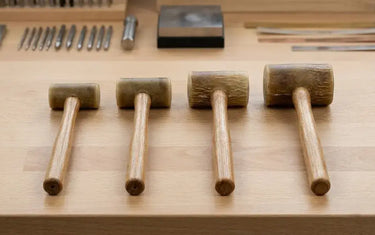
Every hammer blow should shape your jewelry, not ruin hours of hard work. Unlike steel hammers that leave denting marks or rubber that leaves residue, a high-quality rawhide mallet delivers firm, forgiving force to form and flatten precious metals completely scratch-free. Here is how to pick the perfect mallet size for your exact metal gauge and project.
I. Understanding Rawhide Mallet Specifications

To choose the right tool, you first need to understand how a mallet's physical dimensions dictate its performance on the bench.
The Relationship Between Face Diameter and Weight
A rawhide mallet's performance depends on the relationship between its striking face diameter (measured in inches or millimeters) and its overall head weight (measured in ounces).
- Smaller Face Diameters (1.0" / 25mm): Concentrates force onto a localized area. Combined with a lighter head (2–3 oz), this setup provides precise tactile feedback for delicate tasks.
- Larger Face Diameters (1.75"–2.0" / 44–50mm): Distributes the force over a broader surface area. Combined with a heavier head (8–12 oz), it delivers high kinetic energy to move thick gauge stock without leaving deep impressions.
Material and Craftsmanship Standards
Not all leather mallets perform equally under daily bench use. Professional-grade mallets rely on two critical structural elements:
- Tightly Rolled Water Buffalo Hide: High-grade mallets use dense water buffalo hide that is tightly coiled under pressure. This creates a solid striking surface that absorbs high-frequency vibrations while resisting splitting.
- Balanced Hardwood Handles: A well-turned hickory or ash handle balances the weight of the head. The grain orientation should run parallel to the striking force to prevent snapping and minimize shock transfer to your wrist.
II. Rawhide Mallet Size Selection Guide
Matching the mallet size to your specific jewelry-making application ensures clean results and comfortable work.
1. Small Sizes (1.0" / 2–3 oz) – Fine & Precision Work
Small rawhide mallets are designed for delicate tasks where heavy force would distort the workpiece.

- Applications: Fine wire wrapping, resizing delicate wedding bands, shaping earring wires, and forming miniature filigree components.
- Craftsmanship Advantages: Light and nimble, these mallets offer precise control over every strike point. They prevent over-striking, helping you avoid crushed bezels or warped wire layouts.
- Recommended Bench Tool: For precision wirework and small components, the Stuccler 25mm Rawhide Mallet provides ideal balance and lightweight impact control.
2. Medium Sizes (1.25" – 1.5" / 4–6 oz) – The Universal Standard
The medium mallet is the cornerstone of most jewelry benches, handling the widest range of daily tasks.

- Applications: Stretching and forming standard rings on a mandrel, pre-bending cuff bracelets, and planishing 18 to 14 gauge sheet metal.
- Craftsmanship Advantages: Strikes a balance between driving force and hand comfort. It moves medium-gauge silver and gold efficiently while remaining light enough for extended use without causing wrist strain.
- Workshop Standard: The versatile Stuccler 32mm Rawhide Mallet serves as the primary everyday forming tool for most jewelry benches.
3. Large Sizes (1.75" – 2.0" / 8–12 oz) – Heavy-Duty Forming
Large mallets are built for structural metalwork requiring significant force.

- Applications: Bending thick metal stock, forming heavy sterling silver bangles, and rapidly flattening large annealed metal sheets.
- Craftsmanship Advantages: Uses the mallet's momentum to shape heavy metal stock. Because the head does the heavy lifting, you need fewer strikes to move tough metal, speeding up heavy-duty forming tasks.
- Heavy-Duty Option: Explore the Stuccler 44mm–48mm Rawhide Mallet for broad sheet shaping, or choose the lead-core variant when extra driving force is needed.
III. Quick Decision Matrix: Matching Size to Metal Gauge & Project
Use this quick reference guide to select the right mallet size based on your project requirements:
|
Mallet Diameter |
Weight (oz) |
Recommended Metal Gauge |
Primary Applications |
|
1.0" (25mm) |
2 – 3 oz |
20 Gauge & Thinner (< 0.8mm) |
Fine Wire, Earring Components, Delicate Rings |
|
1.25" – 1.5" (32–38mm) |
4 – 6 oz |
18 – 14 Gauge (0.8mm – 1.6mm) |
Standard Rings, Cuff Bracelets, Sheet Planishing |
|
1.75" – 2.0" (44–50mm) |
8 – 12 oz |
12 Gauge & Thicker (> 2.0mm) |
Heavy Bangles, Thick Sheet Forming, Large Mandrel Work |
IV. Key Factors to Consider When Selecting a Rawhide Mallet

When equipping a studio or sourcing tools for production work, evaluate these key details before purchasing.
1. Matching Face Diameter and Head Weight
- Task-Specific Sizing: Match the face diameter to your workpiece geometry. Narrower faces allow you to work inside tight curves or close to set stones, while wider faces prevent edge marks when flattening sheet metal.
- Standard vs. Lead-Core Models: For heavy metalwork, consider a weighted mallet. These models feature a solid lead core embedded inside the rolled hide cylinder. They deliver the driving punch of a heavier tool while maintaining a compact head size.
2. Rawhide Winding Density & Processing
- Structural Density: Inspect the face of the mallet. The hide layers should be tightly bound with no visible gaps between the coils. Loose winding leads to early delamination and uneven striking force.
- Shellac Surface Treatments: Premium mallets are seasoned and shellac-treated. This processing seals out workshop moisture and bench oils, preventing the hide from drying out, cracking, or softening over time.
3. Handle Ergonomics & Structural Stability
- Vibration Absorption: Hickory handles naturally absorb high-frequency impact shocks better than synthetic alternatives, protecting your joints during long planishing sessions.
- Secure Head-to-Handle Anchoring: Check how the mallet head is secured to the handle. Look for models reinforced with cross-pins or heavy-duty anchor screws to ensure the head stays firmly in place under heavy use.
Conclusion
Selecting the right rawhide mallet size protects your work, reduces finishing time, and keeps your hands comfortable at the bench. By pairing light 1.0" mallets with delicate wirework, universal 1.25"–1.5" models with daily ring and bracelet tasks, and heavy 1.75"+ lead-core options with thick sheet metal, you ensure clean, mark-free results every time you strike.
Ready to upgrade your studio setup with professional-grade forming tools? Explore our full collection of shellac-cured, hickory-handled rawhide mallets at LuxgoldTools and find the perfect match for your next jewelry project.
