
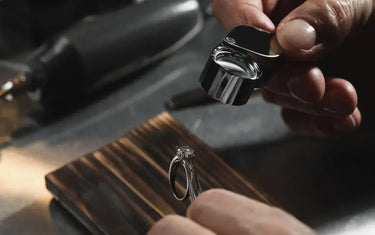
Choosing the right jewelry loupe shapes your daily workflow. While beginners often blindly purchase 30X magnifiers thinking higher is better, a 10X loupe remains the irreplaceable industry standard for fluid stone setting due to its optimal working distance. Save the 30X optics strictly for final, high-precision quality inspection.
Physical Parameter Comparison: Why Magnification Isn't the Only Standard
Magnification power tells only half the story. When working with setting burs, gravers, and hammers, three distinct optical metrics dictate your efficiency.

Working Distance (Focal Length)
- 10X Loupe: Offers a comfortable focal distance of approximately 2.5 cm. This clearance provides ample operational room for vital hand tools. Your pushers, flex-shaft handpieces, and pneumatic gravers move freely without obstruction.
- 30X Loupe: The focal distance typically shrinks to less than 0.8 cm. At this ultra-short range, your steel tools will easily collide with the loupe casing. It severely hinders the stone setting process.
Field of View & Depth of Field
- 10X Loupe: Features a wide, generous field of view. You can simultaneously observe the entire gemstone, the bezel or prong edges, and the flow of the surrounding metal. The deeper depth of field means minor head movements won't break your focus.
- 30X Loupe: Possesses an extremely narrow field of view and a very shallow depth of field. Only a microscopic fraction of the setting stays sharp. Even slight forward or backward movements, or minor hand tremors, cause the image to completely lose focus.
Light Intake & Eye Strain
High magnification demands smaller lenses. As lens diameter decreases, physics dictates a massive drop in light intake.
A 30X lens delivers a significantly darker image to your eye. To compensate, jewelers instinctively squint. Hours of prolonged squinting during observation restrict ciliary muscles. This strain causes rapid optical fatigue, headaches, and can impact an artisan's long-term vision health.
Practical Application Scenarios: How and When to Use the 10X vs. 30X Loupe?
A successful jewelry workshop relies on specific tools for specific tasks. Here is how both optical devices fit into an authentic production workflow.

1. The Setting Process in Action — The 10X’s Absolute Domain
During live metal deformation, context is everything. You need to see how the entire setting responds to pressure.
- Prong & Bezel Setting: Traditional setting requires constant monitoring of prong symmetry and gemstone levelness. A 10X eye loupe delivers the vital overview. It ensures the pavilion seats evenly and the stone remains perfectly aligned without tilting.
- Pavé & Micro-Pavé Setting: Raising tiny metal beads with a spitstick graver requires high visual agility. Your gaze shifts frequently between the layout lines and the cutting edge. The 10X magnification offers excellent tolerance for natural hand tremors. This stability significantly enhances hand-eye coordination efficiency.
2. Final Quality Control & Flaw Detection — Where the 30X Shines
Once the heavy work ends, precision auditing begins. This phase is the sole zone where extreme magnification offers value.
- Hairline Crack Inspection: Brittle gemstones like emeralds, tanzanites, or highly included diamonds risk fracturing under pressure. Tapping prongs or sliding bezels creates intense stress. A 30X lens helps you audit facet junctions. It detects micro-cracks invisible to the naked eye before the piece leaves your bench.
- Micro-Claw Alignment: High-end pavé demands flawless finishing. A quick pass with a 30X magnifying glass verifies that minuscule metal beads are 100% flush against the diamond crown. This step eliminates any potential risk of prongs snagging on a customer’s silk clothing or hair.
Core Comparison Matrix
Choosing the right tool saves time. This matrix contrasts both options across essential workbench parameters:
|
Evaluation Dimension |
10X Jewelry Loupe |
30X Jewelry Loupe |
|
Primary Role |
Production & Operation Tool |
Quality Control & Inspection Tool |
|
Hand Stability Tolerance |
High (Allows for slight hand tremors) |
Extremely Low (Requires a stable support/rest) |
|
Image Brightness |
Ample & Bright |
Dim (Typically requires a strong light source) |
|
Investment Priority |
Essential (100% Priority) |
Optional / Secondary |
|
Industry Standard Recommended Tools |
|
Buying Guide: What to Look For
Low-grade optics ruin good craftsmanship. When sourcing your primary professional jewelry loupe, avoid cheap, injection-molded plastic lenses.

Achromatic & Aplanatic Lenses
Say goodbye to cheap, single-element glass magnifiers. Professional work demands a triplet lens configuration. Three distinct optical glass elements are bonded together to correct internal color dispersion and spherical curvature.
The Triplet Advantage: Achromatic properties eliminate distracting rainbow-colored chromatic aberrations. Meanwhile, the aplanatic design ensures the edges of your visual field remain completely distortion-free.
Light Source Matching
Optics require illumination. It is highly recommended to select an illuminated jewelry loupe featuring a built-in LED or UV light source. If you prefer a traditional unlighted loupe, ensure your bench incorporates a high Color Rendering Index (CRI) shadowless lamp. Crisp, true-to-life lighting prevents misjudging metal thickness or gemstone color depth.
Conclusion
Every tool has its place. The ultimate bench setup formula is simple: a premium 10X Triplet handheld loupe is the essential, standard-issue gear that every jeweler should carry at all times. It is your daily workhorse.
However, your workshop scalability matters. If your studio is handling a high volume of complex Micro-pavé work daily, a 30X handheld device is not the answer. The true factor that creates a significant production efficiency gap is upgrading to a bench-mounted stereo microscope. A microscope gives you 30X vision with the critical working distance of a 10X loupe.
Ready to equip your workbench with optics you can trust? Explore the professional range of precision triplets and illuminated inspection gear at Luxgoldtools to elevate your stone setting accuracy today.
