
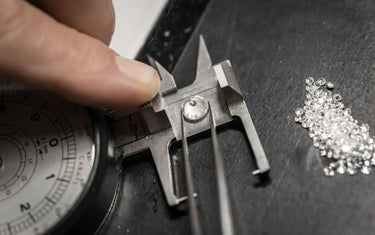
A variance of just 0.05 mm can easily crack an emerald during bezel setting or skew an estate diamond’s valuation by hundreds of dollars. While bulky industrial calipers risk chipping fragile girdles, dedicated gem gauges combine constant-tension springs with specialized probes to deliver zero-compromise precision and total stone safety. Here are four top-tier gem gauges engineered to protect your margins and your stones at the bench.
4 Criteria for Selecting a Professional Gem Gauge

Choosing the right measurement instrument requires balancing mechanical durability against optical and electronic resolution.
1. Actual Tolerance and Resolution
Resolution refers to the smallest increment a screen displays, while tolerance defines the instrument's verified physical margin of error. A digital tool reading to 0.01 mm gives the micro-setter the exact tolerances required to mill stone seats in platinum heads without play. Conversely, an analog dial gauge operating at a 0.05 mm manufacturing tolerance provides the robust repeatability needed when sorting rough parcels under field conditions, where electronic sensor drift cannot be tolerated.
2. Suitability for Set Jewelry
Measuring loose gemstones is straightforward, but evaluating mounted stones inside vintage baskets, illusion heads, and multi-prong settings presents spatial challenges. Standard anvils cannot slip past decorative gallery work. A professional gauge must accommodate ultra-slender needle probes and high-setting attachments to reach deep into prongs and contact the pavilion point squarely, ensuring accurate depth readings without requiring stone unsetting.
3. Gemstone Contact Safety
Excessive spring tension can shear cleavable stones. Pointed contact pins concentrate mechanical load onto a microscopic surface area, which risks fracturing brittle culets or puncturing soft cabochons like turquoise, lapis lazuli, and opal. For loose stone inventory and table-to-culet depth checks, flat parallel disk anvils distribute spring pressure across a wider surface area to eliminate contact marring.
4. Carat Conversion and Data Export
Calculating weight across multiple fancy cuts using manual charts slows valuation workflows and introduces mathematical error. Instruments with onboard mathematical algorithms calculate estimated carat weight instantly from dimensions and specific gravity. For high-volume appraisers, integrated data output pipelines via USB eliminate manual transcription errors and speed up cataloging.
In-depth Comparative Review of 4 Top-Tier Gem Gauges
Each of the following instruments addresses distinct bench demands, from field procurement to high-throughput inventory appraisal.
1. Presidium Gemstone Computer Gauge

Positioning: An all-in-one, intelligent, flagship-level computational gauge.
Key Specifications: 0.0–25.0 mm measuring range, 0.01 mm resolution, and 0.02 mm factory tolerance.
Key Highlights:
- Directly converts physical measurements into estimated carat weight for 9 distinct gemstone cut styles.
- Houses an internal database covering specific gravity values for 74 gem varieties, backed by PC software containing physical constants for 133 gemstone species.
- Features USB connectivity for automated cataloging, an auxiliary high-setting attachment for tall vintage prongs, and an auto-magnetic sleep case that halts battery drain upon storage.
Ideal For: Appraisers, estate jewelry dealers, auction catalogers, and gemological laboratories requiring non-destructive analysis of mounted stones.
2. Presidium Gemstone Digital Gauge

Positioning: High-precision, direct-read digital baseline gauge.
Key Specifications: 0.0–25.0 mm measuring range, 0.01 mm resolution, and 0.02 mm manufacturing tolerance.
Key Highlights:
- Provides one-touch toggling between millimeter dimensions and direct carat weight estimates for round brilliant-cut diamonds.
- Incorporates a dedicated touch-button zeroing feature across any point along its linear track, supported by a smooth-gliding mechanical rail assembly.
- Powered by an energy-efficient circuit drawing from a single CR2032 cell, delivering up to 5,000 operational hours alongside an auto-off magnetic carrying case.
Ideal For: Diamond sorting benches, modern custom design studios, and daily quality control matching stations.
3. Presidium Gemstone Dial Gauge

Positioning: Classic three-in-one analog mechanical lever gauge.
Key Specifications: 0.0–23.0 mm measurement range, 0.1 mm dial increments, and 0.05 mm manufacturing tolerance.
Key Highlights:
- Fully mechanical non-lubricated rack-and-pinion movement that eliminates oil gumming, electronic sensor drift, and dead-battery delays.
- Displays millimeter thickness, round brilliant diamond carat weight, and standard US ring sizes simultaneously on a single high-contrast dial face.
- Includes a factory-machined high-setting needle probe that slips between close-set prongs to measure hard-to-reach pavilion depths.
Ideal For: International trade show buyers, rough-gem procurement in mining regions, and estate sale liquidators.
4. High-Quality Digital Measuring Gem Gauge

Positioning: A precision vertical desktop thickness gauge engineered for ergonomic, one-handed operation.
Key Specifications: 0–12.7 mm measurement range, 0.01 mm / 0.0005” switchable resolution.
Key Highlights:
- Precision-ground, parallel flat anvils distribute spring tension evenly across broad surfaces, preventing fractures on sharp stone culets and preventing scratches on soft minerals.
- Vertical top-mounted spring plunger enables smooth one-handed lifting and releasing, keeping your dominant hand free to control gem tweezers.
- High-contrast digital screen features clear digits that reduce optical fatigue during repetitive sorting runs of calibrated melee parcels.
Ideal For: Wax modelers, micro-pave setters, lapidary workshops, and calibrated pearl sorting.
Comprehensive Performance and Specification Comparison Matrix
| Evaluation Criteria | Presidium Computer Gauge | Presidium Digital Gauge | Presidium Dial Gauge | High-Quality Gem Gauge |
|---|---|---|---|---|
| Measurement Range | 0.0–25.0 mm | 0.0–25.0 mm | 0.0–23.0 mm | 0–12.7 mm |
| Measurement Precision | 0.01 mm | 0.01 mm | 0.1 mm (0.05 mm tolerance) | 0.01 mm / 0.0005” |
| Mounted Setting Support | High-clearance probe included | High-clearance probe included | High-clearance probe included | Loose stones & flat stock only |
| Carat Weight Estimation | Automatic calculation for 9 cuts | Direct readout for round brilliants | Simultaneous dial scale (round brilliants) | Manual calculation required |
| Key Distinct Feature | Gem ID algorithm & PC export | Low-draw circuitry (5,000 hr run) | US ring sizing scale on dial face | Broad parallel anvils, top plunger |
| Power Architecture | 3V CR2450 coin cell | 3V CR2032 coin cell | 100% mechanical (battery-free) | 1.55V button cell |
Presidium Computer Gauge
Accuracy: 0.01 mm | 0.0–25.0 mm Range
Core Feature: 9 Cut Carat Estimates • 133 Gem Species USB Export
Direct carat conversion without unsetting mounted stones. Designed for professional appraisers and auction cataloging.
🟢 In Stock • Genuine Presidium • Fast Dispatch
🛒 Check Price & Details →Presidium Digital Gauge
Accuracy: 0.01 mm | Low-Draw Circuitry
Core Feature: Instant mm/Carat Conversion • 5,000 Hour Battery
Smooth-gliding rail assembly with touch zeroing. Reliable daily workhorse for diamond sorting and custom design benches.
🟢 In Stock • Ready to Ship
🛒 Check Price & Details →Presidium Dial Gauge
Mechanism: 100% Mechanical Rack & Pinion
Core Feature: 3-in-1 Scale (mm, Carats, US Ring Sizes) • High-Setting Probe
Never worry about dead batteries or sensor drift. Unmatched durability for gem shows, field buying, and estate sales.
🟢 In Stock • Precision Analog • Fast Dispatch
🛒 Check Price & Details →Digital Measuring Gem Gauge
Design: Vertical Top Plunger • 0–12.7 mm Range
Core Feature: Wide Parallel Flat Anvils • 0.01mm / 0.0005" Switchable
Parallel flat anvils protect delicate culets and soft cabochons. Keep tweezers free for high-tempo parcel sorting and wax calibration.
🟢 In Stock • High Precision • Ready to Ship
🛒 Check Price & Details →4-Step Standard Operating Procedure (SOP) to Eliminate Measurement Errors

Even the finest gemological gauge will yield inaccurate readings if handled improperly. Follow this standard routine to maintain measurement integrity:
- Zero Calibration and Contact Cleaning: Dust, polishing compound residues, and skin oils can create an artificial gap of 0.02 mm or more. Wipe both contact anvils with a lint-free microfiber cloth before starting. Close the jaws completely under normal spring tension and verify the mechanical zero alignment or press the electronic zero button.
- Controlled, Gentle Resetting: Never let the measuring spindle snap shut against a gemstone. Allowing the spring mechanism to slam the anvils closed shocks internal gears, risks micro-chipping fragile girdles, and can bend delicate needle attachments out of alignment. Guide the spindle back into place smoothly using your thumb or index finger.
- Perpendicular Alignment on Mounted Stones: When using needle attachments on mounted jewelry, keep the probe perpendicular to the table and pavilion planes. Angling the gauge causes diagonal parallax measurement errors, resulting in inflated depth calculations that distort estimated carat weights.
- Routine Block Calibration and Storage Care: Verify your gauge weekly against a certified precision gauge block. When work is finished, store the tool inside its dedicated protective case. Leaving a gauge resting loose on a bench where other heavy tools can press down on the spindle risks bending the internal guide rails.
Choosing the Right Gem Gauge for Your Bench
Selecting the best gem gauge depends on your specific workflow. If your operations focus on multi-cut appraisals and non-destructive valuation of mounted estate jewelry, the Presidium Computer Gauge provides the algorithmic support you need. If you manage a busy workshop requiring rapid, reliable check measurements for diamond setting, the Presidium Digital Gauge delivers long-term battery performance and direct readouts. For gemstone dealers who regularly source goods at trade shows or off-grid mining sites, the battery-free Presidium Dial Gauge remains the most durable choice. Finally, for production jewelers sorting loose melee parcels, calibrating pearls, or cutting wax, the High-Quality Digital Measuring Gem Gauge offers fast, safe, one-handed desktop operation.
Explore our full catalog of professional gem gauges at LuxgoldTools to equip your workbench with the precision instruments your jewelry craftsmanship requires.
