
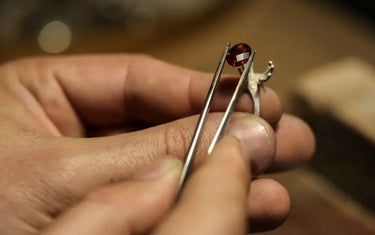
Diamond setting requires ample working space for tools like flex shafts and burnishers, unlike standard gemstone identification. Blindly opting for high magnification narrows your field of view, causing the image to lose focus instantly or leading to tools colliding with the loupe. Choosing the right jewelry loupe is about balancing clarity, working space, and eye comfort.
Step 1: Choose the Right Magnification
When browsing for a gemstone magnifier, magnification is usually the first spec you notice. However, bigger numbers are not always better for workbench bench operations.

Why 10x is the Setter's Gold Standard
A 10x jewelry loupe remains the gold standard starting point for selection. Why? Because 10x offers the most reasonable field of view (allowing you to clearly see the entire diamond and its surrounding prongs) and the longest working distance (providing enough clearance for your tools). It hits the absolute sweet spot for precision and physical space.
When to Choose 5x – 7x
Lower magnification has its place. If you primarily work on bezel settings or model making for larger jewelry pieces, you require a wider field of view to maintain control over overall symmetry. It helps you see the entire ring head layout at once.
Why You Should Avoid 20x/30x for Setting
High-power lenses destroy your workflow. The higher the magnification, the closer the lens must be positioned to the workpiece; this leaves absolutely no room for tool manipulation, and even the slightest tremor in your hand will cause the image to blur. Save the 20x lenses strictly for reading laser inscriptions.
Step 2: Evaluate the "Working Space"
In diamond setting, your hands must move freely. If a lens forces you to work one inch away from your face, it is useless for micro-pave or prong work.

Maintain a Comfortable Gap
Select a lens that allows you to "maintain distance." When making your choice, pay close attention to the lens's focal distance. An excellent setting loupe will allow you to maintain a comfortable gap—at least a few centimeters—between your eye, the lens, and the diamond. This gap keeps your sharp gravers safely away from your optical glass.
Ensure Sufficient Depth of Field
Look for a generous depth of field. Choose a lens that allows for slight forward or backward movement of your hands while the image remains sharp; this prevents dizziness and eye strain when you are continuously tapping down metal prongs. If the depth of field is too shallow, you will constantly fight to stay in focus.
Step 3: Match the Loupe to Your Specific Setting Style
Different setting techniques require specialized optical setups. A professional jeweler loupe should match your daily workload.
|
Your Primary Setting Task |
Recommended Specification |
Why This Configuration Is Best |
|
Micro-Pave / Pavé Setting |
10x Triplet (21mm Large Aperture) |
Since the accent diamonds are extremely tiny, the large 21mm lens allows you to clearly view an entire row of prongs at once, eliminating the need to frequently reposition the loupe. |
|
Main Stone Prong / Bezel Setting |
7x – 10x Standard |
Offers a wider field of view, allowing you to constantly monitor whether the main stone is seated level and if the metal walls are symmetrical. |
|
Final Craftsmanship Inspection (Final QC) |
15x Triplet + LED Light Source |
Used specifically after setting is complete to check for micro-fractures in the accent stones caused by downward pressure, and to ensure that the prongs are fully and securely seated against the stones. |
Step 4: Inspect the Lens and Housing Build
The materials of your pocket magnifier determine its lifespan on a chaotic, dusty workbench.

Lens Selection: The Triplet Requirement
You must choose a "Triplet" lens assembly—a combination of three bonded lenses. Only a triplet design can ensure distortion-free viewing right up to the edges. It corrects both chromatic aberration (color fringing) and spherical aberration (blurry edges). If you opt for a cheaper single or double-element lens, your eyes will become strained and sore after just an hour of use.
Housing Selection: Matching Your Workflow
Your loupe housing needs to survive daily shop abuse. Consider how you prefer to work:
· Heavy-Duty Workbench Use: Choose a solid brass or stainless steel housing; these materials are durable enough to withstand accidental bumps and scrapes against files or flex-shaft handpieces.
· Worn Around the Neck: Choose carbon fiber or lightweight aluminum alloy to minimize strain on your neck and spine during long production days.
Practical Tips: How to Test a Loupe Before Buying
Before committing to a new piece of bench equipment, run these two simple shop tests to verify its quality.
Test for Edge Distortion
Hold the loupe over a sheet of graph paper. Look through the lens at the straight lines. If the grid lines appear curved at the edges, the loupe is defective; this distortion will compromise your ability to judge the straightness of metal lines during the setting process.
Simulate Setting Posture
Do not just look through the lens passively. Bring the loupe up to your eye while holding a setting pusher (or graver) in your hand. Simulate your actual movements. Verify that you can clearly see the diamond while simultaneously maintaining full freedom of movement with your tool.
Conclusion & Recommendation
Selecting the right jewelry loupe for diamond setting is a long-term investment in both your work efficiency and your visual health. Cheap optics lead to misaligned prongs, ruined stones, and chronic headaches.
If you are still undecided, your best choice is a large-aperture (21mm) 10x Triplet (three-element) all-metal folding loupe; this versatile tool will effectively handle 90% of your diamond setting tasks.
Ready to upgrade your bench setup with a high-precision, industrial-grade magnifier? Explore the professional collection at Luxgoldtools, where we supply durable, high-clarity optical tools engineered specifically for master stone setters and jewelry artisans.
