
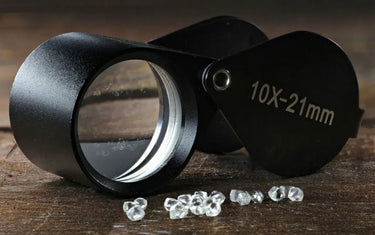
In the absence of a laboratory, a high-quality 10x triplet jewelry loupe (aplanatic and achromatic) is your best defense against 90% of low-grade fakes. As counterfeit hallmarks and glass imitations flood the market, this compact tool replaces risky guesswork with professional confidence.
Master the Mechanics: How to Actually Use a Loupe
Using a loupe correctly requires proper technique. Many beginners fail simply because they hold the tool incorrectly. Follow these standard steps to achieve perfect focus.

- Open & Position: Fully open the loupe. Rest it against your eye socket, eyeglass frame, or brow bone. Keep the loupe perfectly still.
- Bring the Object to the Lens: Hold the jewelry piece in your other hand. Slowly bring it closer to the loupe. Stop when the image comes into sharp focus.
- Anchor Your Hands: Rest your elbows on a sturdy tabletop. Press the fleshy pads at the base of your thumbs firmly together. This creates a stable triangular support. It prevents severe shaking.
- Lighting Angle: Position your light source from a diagonal-overhead or side-rear angle. This technique utilizes transmitted light. Strictly avoid directing light straight onto the gemstone's surface. Doing so causes blinding glare.
Editor's Choice for Flawless Optics: To non-destructively grade stones, professionals rely on uncompromised German engineering. If you seek the absolute gold standard used by top global labs since 1949, look no further than the Harald Schneider® Diamond Loupe LS with its legendary 18mm field of view. Prefer a more substantial, balanced weight in your hand for steady viewing? The Harald Schneider® Diamond Loupe L1 offers an expansive 20mm lens that maximizes light transmission.
Part 1: Decoding Hallmarks (The Metal Blueprint)
A hallmark serves as a piece of jewelry's primary form of identification. It tells a vital story about origin and purity. Under 10x magnification, your focus must shift. Look closely at the traces of the manufacturing process rather than the text itself.

Characteristics of Genuine Hallmarks
Authentic marks are created via traditional mechanical stamping or high-precision laser engraving. Under your jewelry loupe, the base of the lettering appears flat and smooth. The edges remain extremely crisp and regular. You will find no irregular metal burrs or messy, excess metal inside the lines.
Characteristics of Fake Hallmarks
Counterfeit marks tell a different story. They are often created using crude casting molds. This technique results in blurred, soft, or widened lettering edges. Alternatively, budget counterfeiters use low-quality secondary laser engraving. This modern forgery method leaves behind tiny, distinct black burn marks along the edges.
Industry Pitfall Alert: The "Solder Hunt"
Use your loupe to carefully examine the metal surrounding the hallmark. Look closely for faint, visible solder seams or subtle color mismatches. Forgers frequently saw off a genuine hallmark from a scrap piece of antique jewelry. They then weld it onto a fake, low-value ring shank. This deceptive practice is known as "hallmark swapping."
Quick Reference for Key Markings
Always memorize the standard purity codes. They are your first line of defense.
- Pure Gold: Au750 or 18K (denoting 75% pure gold)
- Platinum: Pt950 (denoting 95% pure platinum)
- Sterling Silver: Ag925 or 925 (denoting 92.5% silver)
Look for historic assay office marks too. For example, the British "Leopard’s Head" signifies London testing.
Part 2: Inspecting the Gemstone (Surface & Interior)
Testing gemstones demands a systematic process. Under 10x magnification, observe the physical characteristics using a strict surface-to-interior approach.

1) Surface Observation: Facets & Meet Points
The exterior of a stone reveals its inherent physical properties. Hardness dictates how a material responds to cutting wheels.
- Natural Gemstones & Diamonds: These minerals possess extremely high natural hardness. Under 10x magnification, the facet junctions appear sharp and straight. They look razor-edge crisp.
- Glass & Plastic Imitations: These materials have low structural hardness. They are typically mass-produced via injection molding. Consequently, the facet junctions look rounded and blunt. The soft surfaces often exhibit fine, random scratches from daily wear.
2) Internal Observation: Inclusions vs. Bubbles
Next, peer deep inside the stone. The interior contains clues about its geological formation.
Interiors of Natural Gemstones
Look for natural imperfections. True earth-mined gems are rarely flawless.
- Rubies & Sapphires: Look for needle-like rutile inclusions. These intersect at precise angles, resembling fine, silky threads. You might also spot fingerprint-like fluid or gas inclusions.
- Emeralds: These stones feature complex three-phase inclusions. This is where gas, liquid, and solid crystals coexist. They resemble an intricate, microscopic garden.
Interiors of Artificial Imitations
Look for signs of excessive perfection or industrial manufacturing.
- Glass & Synthetic Stones: You will often find perfectly spherical bubbles. These look like tiny balloons trapped in time. You may also see curved, swirling flow lines. These lines result from the rapid mixing of molten materials during manufacturing.
Best Tools for Heavy-Duty Inspection: Spotting microscopic rutile needles or razor-thin facet junctions requires advanced light management. The Swiss Axe 10X Triplet Loupe integrates Extra Low-Dispersion (ED) glass with a multi-layer anti-reflection coating to actively eliminate glare from bright grading lamps, drastically reducing eye fatigue. For an ultra-lightweight (15g) pocket alternative that brings world-class camera-lens clarity into the field, the Japan-made Nikon 10X Triplet Loupe is the definitive, flat-field industry standard for on-the-go appraisers.
The Limitations: When to Walk Away and Call a Lab

A jewelry loupe is indispensable, but it has definite boundaries. It easily identifies glass, doublet stones, and low-end imitations. However, modern technology presents tougher challenges.
Advanced threats exist. You will encounter high-tech synthetic gemstones like hydrothermally synthesized emeralds. You will find complex CVD or HPHT synthetic diamonds. Furthermore, sophisticated treatments complicate field testing. Heavily lead-glass-filled rubies and microwave-diffusion-treated sapphires look stunning under 10x power.
Definitive identification of these advanced stones requires specialized laboratory equipment. Always remember this crucial rule: if you encounter a gemstone that appears exceptionally clean internally yet carries an unusually low price tag, walk away. Insist on a formal verification certificate from a reputable laboratory like the GIA or GRS.
Conclusion
Mastering the 10x loupe transforms how you evaluate fine jewelry. By stabilizing your hands, analyzing hallmark crispness, and studying facet junctions, you protect your capital from costly mistakes. True expertise combines the right technique with premium optics.
Are you ready to upgrade your field gear? Inspect your inventory with absolute clarity. Explore our professional collection at LuxGoldTools to purchase high-precision jewelry loupes engineered for serious gemstone and metal verification.
