
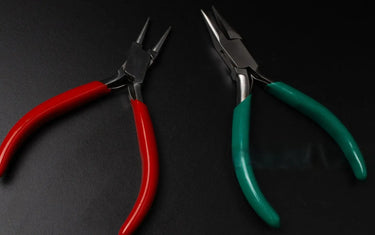
Beginners in wire wrapping often mix up round nose and chain nose pliers. Using the wrong tool can quickly ruin expensive wire. To save your materials and time, remember this simple rule: choose round nose pliers for bending perfect, smooth curves, and choose chain nose pliers for secure gripping and bending sharp right angles.
I. Core Comparison: What Are Round Nose Pliers?

Visual and Structural Features
The jaws of round nose pliers are perfectly conical. They feature a circular cross-section. They taper gradually from the pivot joint down to the very tip.
Unlike standard utility tools, the surfaces—both inside and out—are completely smooth. They have zero serrations. They are seamless. This prevents step-marks on your wire.
Core Functions and Best Uses
These pliers are designed specifically for creating perfect circles, smooth curves, eye pins, head pins, and uniform jump rings. When wrapping wire around the conical jaw, the metal flows into a flawless arc. It creates consistent loops. They excel at wrapped loops in beaded dangles. They manage the fluid geometry of filigree work.
Tip to Avoid Pitfalls
Never use them to tighten or firmly grip flat metal surfaces. They slip. Because the contact area of the curved jaw is mathematically minimal, the tool will slide. It scratches your material. It leaves deep nicks on soft, dead-soft metals like 14K gold-filled or sterling silver wire. Do not twist heavy sheet metal with them. It bends the tips. It ruins jaw alignment.
Product Recommendation: Durston® Professional Round Nose Plier 115mm
Stop fighting with cheap mini-pliers that develop a "wobble" at the joint and twist your wire out of shape. The Durston® Professional 115mm Round Nose Plier is engineered by the UK's premier jewelry tool manufacturer to deliver seamless, repeatable loops that last a lifetime.
- Technical Specs: 23mm Jaw Length | Ultra-fine 0.8mm Tip Width | 115mm Overall Length
- Why You'll Love It: Features flawlessly tapered, mirror-smooth conical jaws that roll dead-soft wire into incredibly tight loops without leaving a single scratch. It boasts a heavy-duty "Forever-Tight" adjustable screw joint—if it ever loosens after years of hardcore crafting, simply tighten the screw to restore day-one factory precision. Complete with snappy double-leaf springs and an elegant, shock-absorbing white poly comfort grip.
II. Core Comparison: What Are Chain Nose Pliers?

Visual and Structural Features
At first glance, chain nose pliers resemble needle-nose pliers, but they have a distinct jewelry-focused anatomy. The outer side of the jaw is rounded. It mimics a half-cylinder. However, the inner side is completely flat. The jaws taper down to a fine, blunt, flat tip. This profile provides maximum surface contact on flat components.
Core Functions and Best Uses
This is your go-to tool for gripping small findings, reaching into tight spaces, pulling wire taut, and bending wire into sharp, crisp 90-degree angles. They are vital. They are the absolute best tool for opening and closing jump rings without twisting them out of round. You hold the ring with one pair. You twist with another. They also tuck raw wire ends neatly into wraps. This prevents sharp edges from snagging on clothing.
Key Crafting Detail (Important)
Jewelry-specific chain nose pliers must have smooth jaws with no teeth. Standard hardware store pliers feature heavy serrations. Avoid them. They act like a file. They will mar the surface of gold, copper, and silver wire. They leave ugly ridges. These ridges ruin your final piece. Smooth jaws rely on precise parallel pressure to hold the wire securely without biting into it.
Product Recommendation: Durston® Professional Chain Nose Plier 115mm
Meet the ultimate daily driver for your jewelry bench. If your current pliers leave ugly teeth marks on your sterling silver, it is time for a massive British-engineered upgrade. The Durston® Professional 115mm Chain Nose Plier provides a 100% mar-free interior to grip your most fragile components with zero risk.
- Technical Specs: 23mm Jaw Length | Goldilocks 1.2mm Flat Tip Width | 115mm Overall Length
- Why You'll Love It: The perfectly machined flat, polished jaw interior relies on parallel pressure to hold fine wires securely. Its 1.2mm tip provides the exact balance of delicate agility and heavy-duty strength needed for tucking raw wire tails, closing jump rings, and making crisp 90-degree bends. Supported by an adjustable lap screw joint and pristine white, ergonomic non-slip handles to eliminate hand cramps during long production days.
III. Quick-Reference Comparison Chart: Decide in 3 Seconds
For quick scanning, use this matrix to match your specific bench task to the correct jewelry plier.
|
Feature / Use Case |
Round Nose Pliers |
Chain Nose Pliers |
|
Jaw Cross-Section |
Perfect circle (Conical) |
Half-circle (Flat interior, round exterior) |
|
Mechanical Action |
Bending, coiling, looping |
Gripping, pulling, flattening, crimping |
|
Best Wire Gauge |
20 to 26 AWG (Optimal for looping) |
18 to 28 AWG (Optimal for holding/tucking) |
|
Angle Creation |
Only continuous curves and arcs |
Sharp 90-degree bends and crisp corners |
|
Jump Ring Duty |
Wraps the wire to make rings |
Opens and closes pre-cut rings |
IV. Advanced Buying Criteria: How to Choose High-Quality Pliers?
From the perspective of a heavy user who spends eight hours a day at the bench, look beyond the basic shape. Pay close attention to these physical specifications:

1. Tip Diameter and Wire Calibration
Micro-wire work (using fine 24 to 28 gauge wire) requires fine tips of 1.0mm - 1.2mm for tiny, neat loops. If the tip is too blunt, your loops look clunky. Standard crafting and heavier wirework (20 gauge and thicker) typically require sturdier 1.5mm - 1.8mm tips. These resist flexing under structural load.
2. Ergonomics and Joint Architecture
High-quality tools feature double-leaf springs. They work well. They automatically return the handles to the open position, reducing micro-strain in your palm. Look for non-slip ergonomic handles. They cushion your grip. More importantly, look for a box-joint construction rather than a lap-joint. Box joints prevent the jaws from twisting sideways over time. They maintain lateral stability.
3. Material and Jaw Alignment
Choose high-grade high-carbon steel or stainless steel. Cheaper alloy tools flex. They warp. When completely closed, the jaws must align perfectly. No gaps should exist from the joint to the tip. Hold the pliers up to the light. Close them gently. If light leaks through the jaws, the tool will drop fine wires.
Conclusion
It is not an "either-or" choice; they are a dynamic duo in jewelry making. One shapes the wire, while the other holds it steady. For any serious artisan, owning both is the right answer.
Ready to upgrade your bench? Start with a tool that guarantees flawless precision. Explore the professional collection at LUXGOLDTOOLS. Our signature Round Nose Pliers are engineered for master artisans and passionate beginners alike. They offer a flawless finish, seamless alignment, and an ergonomic grip that makes wire wrapping effortless.
