
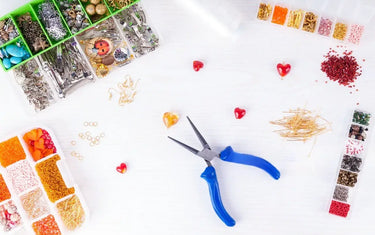
Many jewelry-making beginners struggle with inconsistent loop sizes, deeply scratched metal surfaces, or off-center loops that ruin their designs. The secret to flawless wire jewelry lies in mastering the anatomy and mechanics of round nose pliers. By learning a few precise techniques, you can easily create beautiful, commercial-grade loops that look boutique-quality and Etsy-ready.
Part 1: Getting to Know Your Tool (Anatomy of Round Nose Pliers)
What are round nose pliers? Unlike standard flat nose or chain nose pliers, these specialized hand tools feature two smooth, completely toothless, conical jaws. They are engineered specifically for bending sweeping curves, loops, and custom ear wires without pinching the metal flat.

Key Feature: The Tapered Jaws
The defining characteristic of this tool is its gradual taper. The jaws are wide at the base and narrow down to tiny, precise points at the tips. This conical geometry allows you to create multiple loop sizes with a single tool.
- The Tips: Used for creating tiny loops (approx. 1mm - 2mm in diameter). This section is ideal for delicate earring hooks or fine wire wrapping.
- The Base: Used for creating larger, structural loops (approx. 4mm - 5mm in diameter). This thicker section provides the leverage needed to form sturdy links for chunky statement chains.
The Essential Bench Tool Matrix
Round nose pliers cannot work in isolation. To achieve clean results, you must use them as part of a coordinated bench setup.
- Flush Cutters: These are essential for creating a perfectly flat, clean cut on your jewelry wire, eliminating sharp burrs.
- Chain Nose Pliers: Featuring flat inner jaws and a tapered exterior, they are your primary partner tool for gripping, opening, and securely closing wire loops.
Part 2: Essential Bench Preparation
Before touching your wire to the tool, you must address the root causes of the two most common user frustrations: inconsistent loop sizes and tool-induced scratches.

Tip 1: The Sharpie Trick (Achieving 100% Consistency)
Because the jaws are conical, wrapping your wire even a fraction of a millimeter too high or too low will change the final loop size. When you are making a matching pair of earrings or a uniform pearl tin-cup necklace, inconsistency looks highly unprofessional.
The Fix: Take a fine-point permanent marker (like a Sharpie) and draw a crisp line directly across one of the conical jaws at your desired diameter. When performing batch production, simply align your wire with this black mark every single time. Your loops will turn out identically sized. The marker line easily wipes off later with a splash of rubbing alcohol.
Tip 2: Protecting Delicate Wire Coatings
Even though quality round nose pliers have completely smooth jaws, applying heavy hand pressure against a hard steel surface can easily mar soft metals like sterling silver, 14k gold-filled, or colored craft copper wire.
- The Micro-Tape Method: Wrap a single, tight layer of microporous medical tape or electrical tape around the jaws. This creates a thin, forgiving cushion.
- The Tool Dip Method: Dip the jaws into a specialized liquid rubber compound (such as Tool Dip). This leaves a durable, non-slip protective coating that prevents any metal-on-metal scratching.
Part 3: Core Practical Instruction—Creating the Perfect Simple Loop
A simple loop (often called a P-loop or eye-pin loop) is the foundational building block of beaded jewelry links. Follow these four precise steps to master the mechanics.

Step 1: Precise Positioning
First, use your flush cutters to make a clean, 90-degree cut at the end of your wire. Hold the round nose pliers in your dominant hand. Grip the very end of the wire at your pre-marked spot on the jaw.
Crucial detail: The wire end must sit completely flush with the top edge of the jaw. Run your index finger over the top of the pliers—you should feel a smooth metal surface, with absolutely no sharp wire tip protruding past the jaw. If it sticks out, your loop will have an ugly tail.
Step 2: The Crucial 90-Degree Bend
Do not start wrapping the wire immediately! If you simply wrap the wire around the jaw from this position, your loop will sit off to the side, resembling a crooked letter "P".
- Using your non-dominant hand, firmly push the wire away from you, bending it backward over the jaw at a sharp 90-degree angle.
- This simple movement creates a structural "neck" or "stem".
- This mechanical break ensures that when the loop is fully formed, its center sits perfectly straight on the main axis of the wire.
Step 3: The Wrist Roll
Now, loosen your grip slightly without letting the wire move from its marked position. Rotate your pliers toward you, clamping down right in the crook of that 90-degree bend.
Using your dominant wrist, roll the pliers forward in an outward, clockwise motion. As you rotate your wrist, guide the wire smoothly over the top jaw.
Technique tip: The movement must come entirely from a fluid rotation of your wrist, like turning a key in a lock. Do not use your fingers to stiffly force or bend the wire around the tool.
Step 4: Closing the Loop Perfectly
Once the wire has wrapped completely around the jaw to form a full circle, open the jaws and remove the round nose pliers. You will notice a tiny, microscopic gap where the wire tip meets the stem.
Switch to your chain nose pliers. Grasp the loop flat between the jaws and give it a very gentle, subtle twist backward and inward. You should feel the wire settle flush against the main stem with zero gap, ensuring fine bead headpins or silk threads cannot slip out.
Part 4: Advanced Challenge—Creating a Wrapped Loop
Once you master the simple loop, you should advance to the wrapped loop. Wrapped loops are structurally locked. They are vital for high-end artisan jewelry, heavy gemstone drops, or dangle earrings that need to withstand daily wear without opening up.

Technical Differences and Execution
The wrapping process requires a slightly adjusted blueprint to accommodate the extra metal bulk.
- The Extended Neck: When performing your initial 90-degree bend (Step 2), do not place the wire flush against the jaw. Instead, leave a clear gap of approximately 2mm - 3mm between the pliers and your bead. This space provides the designated runway for your wraps.
- Forming the Loop: Roll your loop exactly as you did before, forming a clean circle above that extended neck.
- Executing the Wraps: Remove the round nose pliers. Securely clamp the round loop flat inside the jaws of your chain nose pliers to stabilize it. Grasp the remaining tail of the wire with your fingers or a second pair of pliers, and tightly wind it downward around the neck.
- The Finish: Complete 2 - 3 tight, symmetrical coils. Use your flush cutters to snip the excess tail wire as close to the wraps as humanly possible. Finally, use your chain nose pliers to gently tuck and press the sharp remaining point flat against the stem so it won't catch on clothing or skin.
Part 5: 4 Common Mistakes for Beginners (Troubleshooting)
Mistake 1: The loop looks like a "P" or a comma
- The Cause: You forgot to make the initial 90-degree pre-bend.
- The Fix: Always break the wire backward before rolling the loop forward to center the eye.
Mistake 2: The loop is asymmetrical or has a flat spot
- The Cause: You paused mid-roll, repositioned the pliers improperly, or squeezed the handles too hard, crushing the wire curve.
- The Fix: Maintain a firm but gentle grip and practice a single, continuous wrist rotation.
Mistake 3: The pliers slip and mar the wire coating
- The Cause: Your hand grip is too loose, or you are trying to bend an incredibly stiff, heavy-gauge wire (like iron or stainless steel) using the delicate tips of the pliers.
- The Fix: Use appropriate jewelry wire gauges (ideally 20-gauge to 24-gauge for beginners). Work closer to the middle or base of the jaw if the wire offers high resistance.
Mistake 4: Severe hand and wrist fatigue
- The Cause: Choking up on the tool. Gripping the metal head or sitting too close to the joint destroys your mechanical advantage.
- The Fix: Hold the handles further toward the middle or back. Let the tool's leverage do the heavy lifting. Rest your elbows on your jeweler's bench for stability.
Conclusion
Beautiful wirework is not an innate talent—it is a mechanical habit. By executing the 90-degree pre-bend, marking your tool jaws for consistency, and letting your wrist drive the rotation, you can eliminate amateur mistakes and create striking, professional results.
To achieve truly flawless wirework, the precision of your hand tools matters just as much as your technical execution. High-performance jewelry making requires perfectly aligned, ultra-smooth conical jaws that leave zero marks, coupled with ergonomic handles that protect your hands during long production runs. Explore the premium professional lineup at LuxgoldTools to find industrial-grade round nose pliers engineered specifically for elite artisan wire manipulation, and elevate your studio production standards today.
