
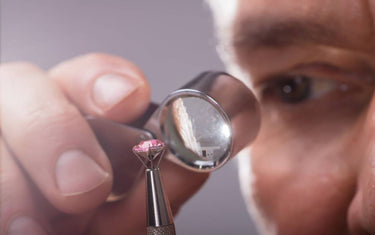
The margin for error in precision grading is virtually nonexistent. Whether in a lab or at a trade show, a professional optical instrument is essential. Here are the top 5 loupes for 2026, selected for their flawless optical distortion control, mechanical durability, and adherence to gemological standards.
I. Core Selection Criteria
Understanding the engineering behind a professional jewelry loupe is essential for making an informed investment.

1. Magnification Standards
For serious gemological work, 10X magnification is the absolute industry standard.
- The GIA Benchamrk: The Gemological Institute of America (GIA) and other major laboratories base their diamond clarity grading explicitly on what is visible under 10X magnification.
- The Threshold: Anything less will miss critical inclusions; anything more will drastically reduce your depth of field and make hand-held focusing nearly impossible.
2. Optical Correction
A cheap magnifying glass will distort reality. Professional grading loupes must feature two specific optical corrections:
- Achromatic: Ensures that light passing through the lens does not separate into rainbow-colored fringes around the edges of the gemstone. It guarantees accurate color grading.
- Aplanatic: Corrects spherical aberration. It ensures that the field of view remains flat and grid lines or facets at the very edges of your vision remain crisp and undistorted.
3. The Truth About Lens Construction
The physical architecture of the lens dictates its optical performance. It is vital to distinguish between a true fixed 10X Triplet lens and a magnification system composed of two separate, independent lenses.
- True Triplet: Consists of three distinct lenses bonded together to form a single, highly corrected optical unit, providing the superior sharpness required for pinpointing minute pinpoint inclusions.
- Dual-lens System: Allows the user to swing out individual lenses or stack them. While versatile, dual systems perform differently under strict 10X grading conditions compared to a dedicated fixed triplet.
4. Anti-Reflective Coating & Housing
The physical build of the loupe matters just as much as the glass. A professional loupe will feature a matte black internal coating around the lens to absorb stray light and prevent glare. Furthermore, the exterior housing should be constructed from durable materials like aluminum alloy or brass to withstand drops and the rigors of travel.
II. The 5 Best Loupes for Precision Grading in 2026
Based on rigorous optical standards, material engineering, and field reliability, here are the top five hand-held magnifiers for industry professionals.
1. Zeiss Triplet Loupe D40

- Key Selling Points: TThe D40 redefines professional optics by housing its high-grade optical glass inside an ultra-lightweight, reinforced polymer shell. Featuring an advanced aspherical triplet design, it guarantees a crisp, distortion-free achromatic and aplanatic image. This intelligent combination of pristine glass optics and robust material engineering makes it the ultimate feather-light everyday carry (EDC) tool.
- Ideal Application: Perfect for master gemologists who conduct hours of continuous diamond clarity grading and require zero neck or hand fatigue without compromising edge-to-edge Zeiss clarity.
2. SCHNEIDER Diamond Loupe L2 (10X)

- Key Selling Points: Representing the pinnacle of Harald Schneider's German engineering, the L2 features a specialized ultra-thin glass construction (a streamlined 14mm profile) weighing only 2.46 oz. It boasts a massive 20mm lens diameter with a distinctive purple anti-reflective coating, offering exceptional light transmission and an expansive, distortion-free field of view.
- Ideal Application: Master gemologists and high-volume buyers who need to inspect stones rapidly. The oversized lens reduces eye strain, and the matte black casing eliminates harsh reflections under grading lamps.
3. ZEISS Double Pocket Magnifier D36

- Key Selling Points: Distinct from fixed triplet structures, the D36 offers 3-in-1 versatility with a unique double-lens design. Users can utilize the 3x or 6x lens individually for broader scanning, or combine them for a powerful 9x magnification. Both lenses feature the proprietary ZEISS T* multi-layer anti-reflective coating to maximize contrast, housed in a shock-proof polymer shell with a generous 22mm diameter.
- Ideal Application: The ultimate versatile tool for quick parcel sorting, preliminary gemstone screening, and adaptable bench work where switching between magnification powers is highly beneficial.
4. Nikon 10X Triplet Loupe

- Key Selling Points: Proudly Made in Japan, this loupe brings world-class Nikon camera lens technology to gemology. Weighing a mere 15g, its 13mm aspherical triplet lens provides a perfectly flat field of view. The matte black interior frame actively absorbs stray light for color-accurate grading, while the resin and metal body features a specialized anti-scratch coating.
- Ideal Application: An outstanding, highly durable daily driver for jewelry retailers and students who demand strict GIA-standard 10X grading from a legendary optical brand.
5. ESCHENBACH Plastic Precision Folding Magnifier (10X)

- Key Selling Points: Built for demanding industrial environments, this German-made aplanatic loupe features a rugged, glass-fiber reinforced polyamide body. Weighing approximately 23g with a 21mm effective glass lens, its precision-engineered casing forms an air-tight seal when folded, preventing abrasive dust and debris from scratching the optics.
- Ideal Application: The ultimate durable choice for professionals, bench jewelers, and traveling buyers who need a reliable, distortion-free tool that can withstand accidental drops and heavy workshop use.
III. How to Use a Loupe Like a Professional
- Proper Technique: Do not move the loupe back and forth. Instead, hold the loupe firmly against your cheekbone or right in front of your eye (approximately one inch away) to stabilize it. Anchor your elbows on a table if possible. To bring the diamond into focus, slowly move the gemstone or your tweezers toward the lens, rather than moving your head.
- Lighting Integration: When examining inclusions, utilize darkfield illumination—lighting the stone from the side against a dark background—to make inclusions stand out. For surface graining or polishing marks, utilize professional overhead daylight-equivalent lighting to reflect off the facets.
Conclusion
Choosing the right jewelry loupe depends entirely on your daily professional demands. If your goal is absolute, uncompromised GIA-standard grading, investing in a true fixed 10X triplet like the Zeiss D40 or the Schneider L2 is essential. If you require flexibility or heavy durability for travel, the Zeiss D36 or the Eschenbach are highly effective choices.
Precision begins with the right lens. Don't let a subpar tool compromise your grading accuracy. At LuxGoldTools, we curate only the world’s most elite optical instruments—including the industry-leading loupes featured in this guide. Shop the 2026 Professional Collection at LuxGoldTools today and see your gemstones in a new light.
