
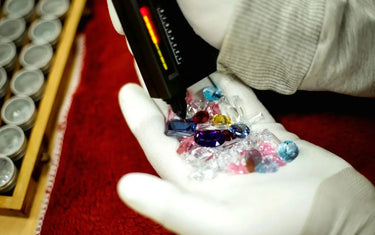
Spotting premium fakes like CVD diamonds or moissanite is nearly impossible with the naked eye. Buying the wrong testing device can lead to costly false readings and severe financial losses. This quick guide breaks down essential gem tester specifications to help you easily choose the most accurate tool for your business.
I. The Basics: How Do Gem Testers Work?
Professional gemological instruments rely on precise material science to isolate distinct physical, thermal, or optical profiles. Understanding how different testing technologies function is key to choosing the right tool.

1. Testing Based on Thermal Conductivity
Natural diamonds are among the most thermally conductive materials on Earth. Entry-level tools, like the classic Diamond Selector II, utilize a heated thermistor tip to measure the exact rate of heat dissipation from the stone's surface. This mechanism easily separates real diamonds from non-conductive simulants like cubic zirconia (CZ) or glass.
2. Testing Based on Dual Thermal/Electrical Properties
Moissanite poses a huge challenge because its thermal profile overlaps almost perfectly with natural diamond, causing standard thermal pens to fail. Advanced testers solve this by adding an electrical conductivity channel. Since moissanite conducts electricity (semiconductor) and diamond acts as an absolute insulator, the dual-property check successfully flags the threat.
3. Testing Based on Optical & Spectroscopy Analysis
Colored gemstones like rubies, sapphires, and emeralds do not share the thermal properties of carbon stones, making diamond pens useless. Identifying these precious minerals requires instruments that measure the Refractive Index (RI) or deploy specific short-wave and long-wave ultraviolet (UV) light to analyze the stone's internal crystal structure.
II. Key Evaluation Criteria: 4 Crucial Details for Determining Accuracy

1. Probe Tip Material & Diameter
The probe tip is the heart of the device. Avoid brittle copper or low-grade steel tips that oxidize quickly. Look for premium copper-tungsten alloys or micro-sized thermoelectric probes that maintain constant contact pressure, allowing you to get stable readings even on tiny melee diamonds down to 0.01 carats.
2. Active Metal Alert
When testing mounted jewelry, a probe can easily slip off the gemstone and hit the metal setting. Because gold and silver are excellent thermal conductors, basic pens will misread the metal as a diamond. A reliable tester must feature a capacitive metal alert that instantly beeps and zeroes out the reading upon metal contact.
3. Automatic Internal Calibration
Thermal conductivity readings drift easily with changes in room temperature or air conditioning. Premium testers feature onboard microprocessor units (MCUs) that automatically run internal calibration sequences upon startup, ensuring repeatable, accurate results whether you are in a cold warehouse or a hot trade show.
4. Triple-Signal Indication
Appraisal environments are often loud or poorly lit. Choose devices that provide clear, unambiguous feedback through a triple system: Visual (high-contrast LED/LCD), Audible (variable-pitch tones for different materials), and Tactile/Digital on-screen notifications that leave zero room for error.
III. Selection Matrix: How Should Different Buyers Choose?
Your equipment choice should align perfectly with your daily workflow volume and the stakes of your transactions.
1. Novice Buyers & Couples Preparing for Weddings
- Primary Needs: Occasional screening of personal engagement rings, heirloom jewelry, or loose stones purchased online.
- Budget Priority: Cost-efficiency combined with reliable protection against basic fraud.
- Recommended Tool: Diamond Selector II or Diamond Tester with UV. These portable and budget-friendly devices offer essential protection by accurately running quick spot checks on diamond simulants.
2. Second-hand Jewelry Dealers, Pawn Shops & Artisan Studios
- Primary Needs: High-frequency, rapid-fire testing of diverse inventory. This includes sorting large batches of loose melee stones, appraising complex antique settings, and identifying colored gemstones.
- Budget Priority: Maximum accuracy, long-term durability, and professional compliance.
- Recommended Tool: Presidium Multi Tester III, GemOro® Testerossa, or SmartPro Gem-Eye-I Gemstone Tester. These high-precision instruments utilize advanced micro-probe tips, thermoelectric testing, or refractive indexes to offer multi-stone testing capabilities with commercial-grade speed and reliability.
IV. Pitfalls & Best Practices: How to Ensure 100% Accuracy?
Even the most advanced electronic tester will fail if user protocols are ignored. To achieve absolute accuracy during your testing process, implement these mandatory industry best practices.

Cleanliness First
Before the probe tip ever touches a gemstone, the stone must be thoroughly prepared. Use a clean microfiber polishing cloth to wipe away all body oils, lotion residue, dust, and fingerprints. Surface oils form a microscopic barrier that severely compromises electrical conductivity readings, causing false negatives.
Technique Matters
Hand position and angle are critical. The testing probe pen must be held exactly perpendicular—at a strict 90-degree vertical angle—relative to the gemstone's flat table facet.
Apply moderate, completely uniform pressure. Do not push down with excessive force, as you risk bending the delicate micro-probe tip. Never tilt the pen or drag it across the stone during the measurement cycle.
Understanding Limitations
Every professional must understand the fundamental boundaries of standard testing technology. The vast majority of standard thermal and electrical gemstone testers on the market cannot distinguish between natural mined diamonds and lab-grown diamonds (CVD or HPHT).
Because lab-grown diamonds are chemically, physically, and optically identical to natural diamonds, they share the exact same thermal and electrical properties. A standard tester will rightfully label a CVD stone as "Diamond." To separate lab-grown diamonds from earth-mined diamonds, you must step up to specialized UV spectroscopy, phosphorescence detectors, or Laue diffraction equipment that can read structural growth patterns.
Conclusion
Securing an accurate testing device does not have to be a confusing process. The secret lies in matching the tool to your inventory requirements—ensuring you have dual thermal-electrical capabilities for diamonds, and proper micro-probe engineering for fine jewelry settings.
If your business demands commercial-grade durability and uncompromised precision, look to industrial-grade manufacturing. Explore the advanced product lineup at LuxgoldTools. We manufacture high-caliber gem testers designed to withstand heavy daily use in demanding commercial and appraisal environments. Visit LuxgoldTools today to secure your inventory and protect your bottom line with professional-grade accuracy.
